 ArtGuess.io
Indian Modernism: How Amrita Sher-Gil and Jamini Roy Reinvented Indian Painting
By Bruno, Founder of ArtGuess.io
• 9 min read
In the early twentieth century, Indian artists faced a question with no easy answer: what should modern Indian art look like? For decades, the British-run art schools in Calcutta, Bombay and Madras had taught students to paint like Victorian academicians, with oil portraits, classical anatomy and European landscapes. At the same time, the struggle for independence was making many Indians ask whether art, too, needed to be decolonised.
Two painters of the 1930s gave strikingly different answers. Amrita Sher-Gil (1913–1941) trained in Paris and brought the language of European modernism home to paint Indian life with new seriousness. Jamini Roy (1887–1972) trained in the academic style and then turned his back on it completely, rebuilding his art from the folk traditions of rural Bengal. Their work in ArtGuess.io spans India from the Punjab to Calcutta, and learning to tell them apart is one of the most satisfying skills in the game.
The First Answer: The Bengal School
To understand both artists, start in Calcutta (now Kolkata) at the turn of the century. In 1905 the British partitioned Bengal, sparking the Swadeshi movement, a campaign to boycott British goods and revive Indian ones. That same year, Abanindranath Tagore, a nephew of the poet Rabindranath Tagore, painted Bharat Mata (Mother India).
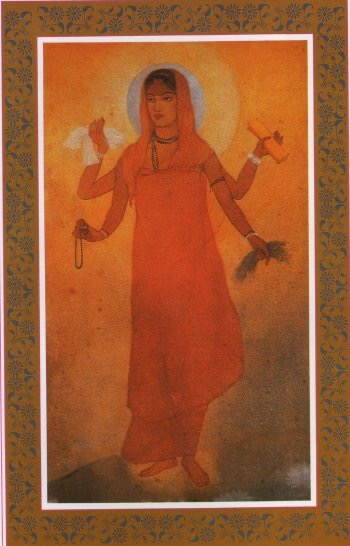
Bharat Mata (1905), Abanindranath Tagore, Calcutta
The nation appears as a calm young woman in a saffron robe, with four arms like a Hindu goddess. In her hands she holds a book, sheaves of rice, a white cloth and a string of prayer beads: learning, food, clothing and spiritual life. Tagore deliberately rejected oil paint for a soft watercolour wash, a technique influenced by Japanese artists who visited Calcutta at the time. He and his students, known as the Bengal School, looked back to Mughal miniatures and the ancient murals of Ajanta for a style that felt authentically Indian.
The Bengal School was enormously influential, but by the 1930s many younger artists found its misty, nostalgic style too gentle for a modern country. Sher-Gil and Roy both reacted against it, in opposite directions.
Amrita Sher-Gil: From Paris to the Punjab
Amrita Sher-Gil was born in Budapest in 1913 to a Hungarian mother, the singer Marie Antoinette Gottesmann, and a Sikh aristocrat father, Umrao Singh Sher-Gil, a scholar of Sanskrit and Persian and a keen photographer. Her family moved to India in 1921 and settled in Shimla, the summer capital of British India in the Himalayan foothills.
At sixteen she went to Paris to study at the École des Beaux-Arts. She absorbed the work of Gauguin, Cézanne and Modigliani, and in 1933 she became one of the youngest artists, and the only Asian, to be elected an associate of the Grand Salon. But she grew restless. Europe, she later said, belonged to Picasso, Matisse and Braque; India belonged to her. At the end of 1934 she returned home, determined to paint Indian life as no one had before.
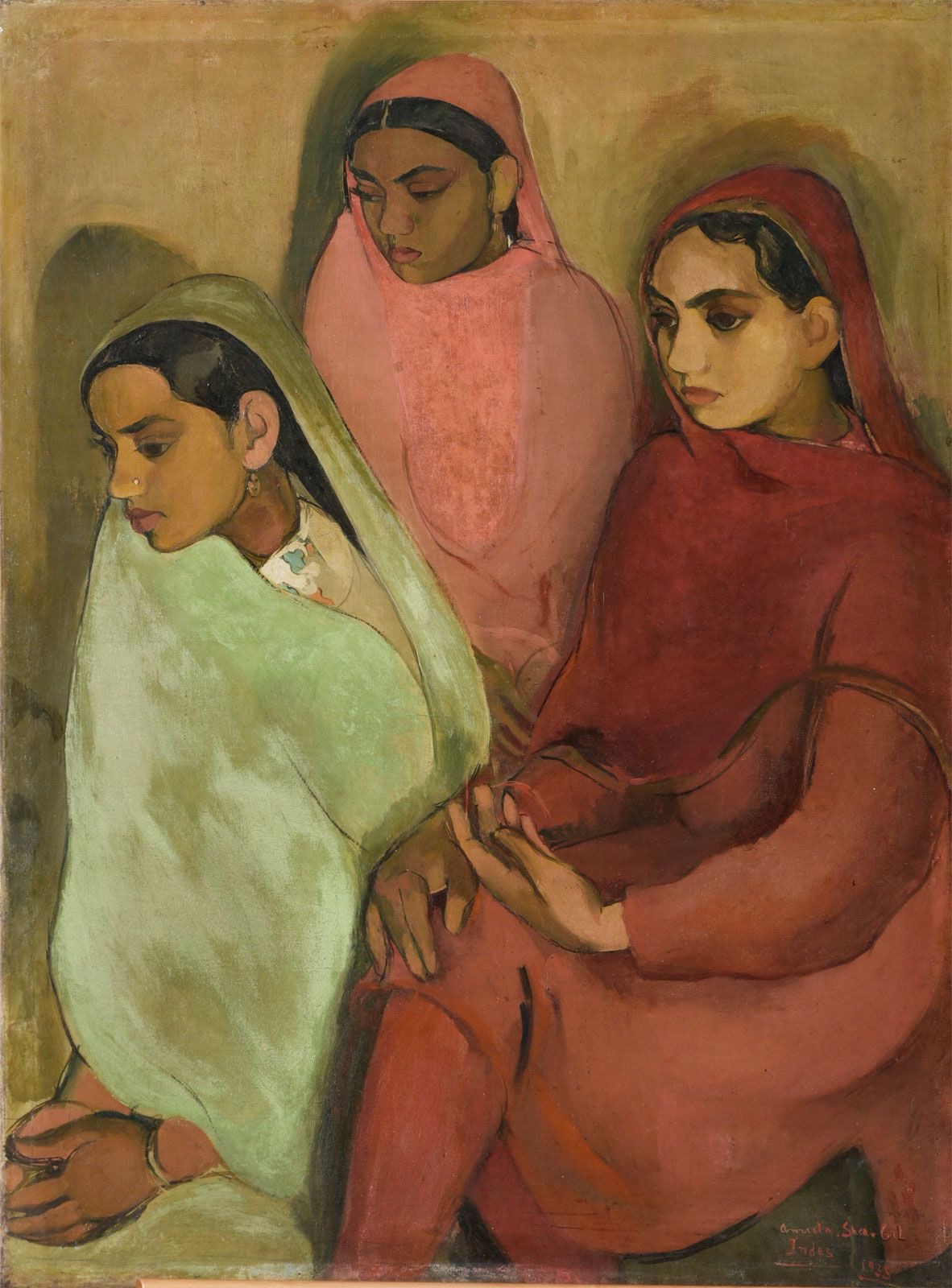
Three Girls (1935), Amrita Sher-Gil, oil on canvas
Three Girls, painted the year after her return, shows how quickly she found her voice. Three young women in green, pink and deep red sit close together, eyes lowered, waiting. Nothing happens, and that is the point: Sher-Gil painted the quiet melancholy of women's lives with a dignity that had little to do with the picturesque "Oriental" scenes painted by European visitors. The muted earth background, the simplified forms and the warm, glowing skin tones would become her signature. The painting won the gold medal of the Bombay Art Society in 1937.
The Journey South
In 1936 and 1937 Sher-Gil travelled widely across India. The ancient Buddhist cave murals at Ajanta overwhelmed her, and in the south she was struck by the colour and grace of everyday life. Back in Shimla she painted a celebrated trio of South Indian scenes, including Brahmacharis (1937).
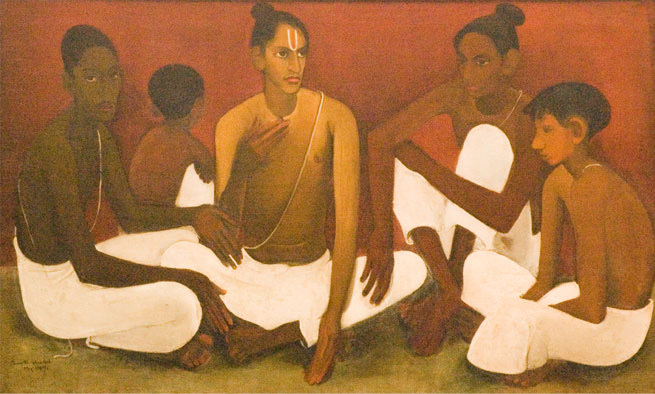
Brahmacharis (1937), Amrita Sher-Gil, painted in Shimla
Five young Brahmin students sit cross-legged in white dhotis against a flat, red-brown wall. One wears the sacred thread across his chest and the white and red tilak marks of a Vaishnava devotee on his forehead. The dark skin, the frieze-like arrangement of figures and the strong, simple colours show the Ajanta murals digesting into a modern style. This is a perfect example of a geographic trap: the subject is southern India, but the painting was made more than 2,000 kilometers away in the Himalayan foothills.
In 1938 Sher-Gil married her Hungarian cousin, Victor Egan, and they lived first on her family's estate at Saraya, near Gorakhpur, and then in Lahore. There, in December 1941, she fell suddenly ill and died at the age of just 28. She left fewer than 200 paintings, but today India has declared her work a National Art Treasure, and she is often called the founder of modern Indian painting. (If her Hungarian heritage interests you, read our guide to another great Hungarian painter, Mihály Munkácsy.)
Jamini Roy: Turning Back to the Village
Jamini Roy took the opposite road. Born in 1887 in the village of Beliatore, in the Bankura district of rural Bengal, he studied at the Government School of Art in Calcutta and became an accomplished painter of academic portraits and landscapes in oil. By the 1920s he had come to feel that this borrowed European style had nothing to do with the people around him.
He found his answer in two Bengali traditions. The first was Kalighat painting: quick, bold watercolours sold to pilgrims outside the Kali temple in Calcutta in the nineteenth century, with sweeping outlines and flat colour. The second was the painted scrolls (pats) and terracotta temple sculpture of village Bengal, including his native Bankura. Roy abandoned oil paint and European canvas, made his own pigments from earth, chalk, lamp soot and plants, and painted on cloth, board and paper.
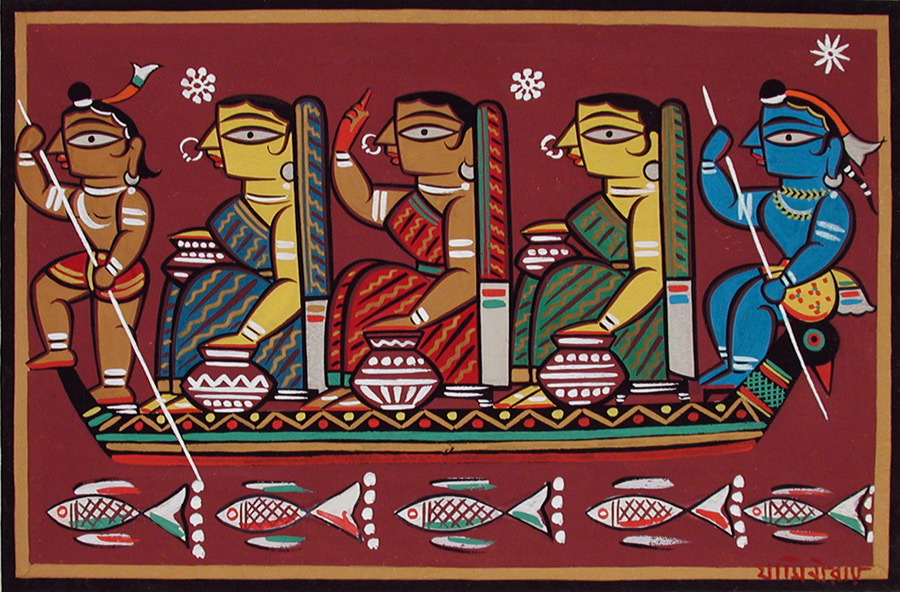
Boating, Jamini Roy, Calcutta (Kolkata)
Boating shows everything that makes his mature style unmistakable. Three women sit in a long boat between two oarsmen, one of them painted blue, the colour of the god Krishna. Every figure has the same huge almond-shaped eyes, heavy black outlines and flat areas of colour, set against a plain red-brown ground. Rows of stylised fish swim below, and simple white flowers float in the sky. There is no perspective, no shading and no attempt at realism; the painting works like a decorative frieze or a folk scroll.
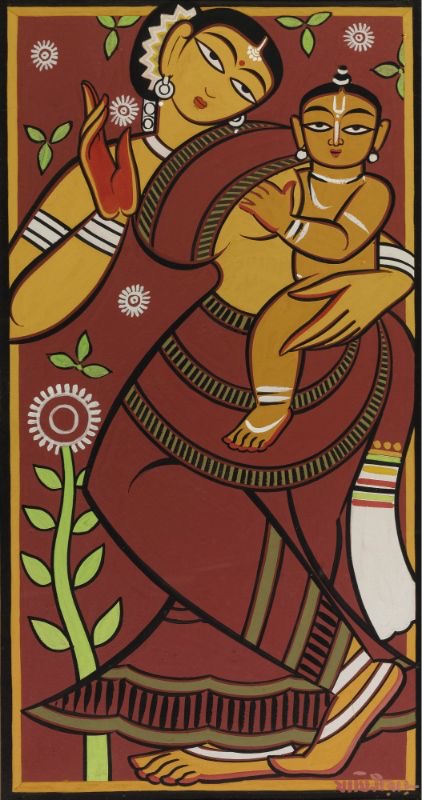
Mother and Child (1940), Jamini Roy, Calcutta (Kolkata)
Roy painted the same subjects many times: Krishna and his companions, Santhal tribal women, cats, and above all mothers and children. Mother and Child (1940) is a classic example, with its tall format, sinuous lines and patterned sari border. He wanted art to be affordable for ordinary Indians rather than a luxury for collectors, so he and his family workshop produced many versions of his designs and sold them cheaply. His work was exhibited in London and New York in the 1940s and 1950s, and in 1955 he received the Padma Bhushan, one of India's highest civilian honours.
Sher-Gil vs. Roy: How to Tell Them Apart
What Came Next
After independence in 1947, a new generation took up the question Sher-Gil and Roy had asked. In Bombay, the Progressive Artists' Group, founded that year by painters including F. N. Souza, S. H. Raza and M. F. Husain, pushed Indian art towards bold, international modernism. Tyeb Mehta, a close associate of the group, spent decades refining an art of flat colour and dramatic diagonal lines.
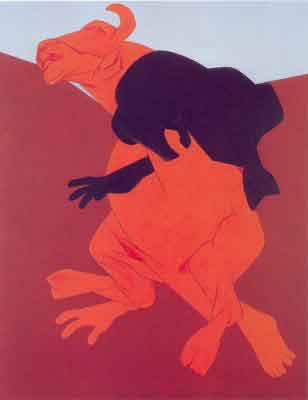
Mahishasura (1997), Tyeb Mehta, Mumbai
His Mahishasura (1997) shows the goddess Durga locked in combat with the buffalo demon, reduced to a few interlocking planes of orange, black and red. Like Roy, Mehta drew on Bengali religious imagery, which he encountered during a fellowship at Santiniketan in Bengal; like Sher-Gil, he spoke the language of international modern art. In 2005 the painting became the first work by a contemporary Indian artist to sell for more than a million dollars at auction, a sign of how far Indian modernism had travelled.
Pinpointing Indian Modernism in ArtGuess
- Flat colour and heavy outlines mean Bengal: If a painting looks like a folk scroll, with big eyes, black contours and a plain coloured background, think Jamini Roy and drop your pin on Kolkata.
- Oil paint and quiet faces mean the north: Sher-Gil's figures are modelled in oil with a gentle, brooding mood. She worked mostly in Shimla and the Punjab, so aim north, not south, even when her subjects are South Indian.
- Soft watercolour washes mean early Calcutta: Misty, delicate washes and nationalist or mythological subjects point to the Bengal School around 1900–1930.
- Bold modern abstraction means Bombay: Post-independence works with hard-edged shapes and strong diagonals often come from Mumbai's Progressive circle.
- Don't forget older Indian art: ArtGuess.io also includes Mughal paintings from Agra, Pahari miniatures from Kangra and Rajput works from Kishangarh, the very traditions Sher-Gil studied. Fine detail, gold and jewel-like colour usually mean these earlier courts.
Try it yourself: Set the region filter to Asia and the century filter to the 20th century to practice on these works, or explore more painters in our Artist Guides.
Two Roads to a Modern India
Sher-Gil and Roy never formed a movement together, and their paintings could hardly look more different. Yet they shared a conviction that Indian art had to be rooted in Indian life rather than imported from London. One found that root by looking at her country with the eyes of a Paris-trained modernist; the other found it in the village scrolls of his childhood. Between them they showed that there was more than one way to be both modern and Indian, and every artist who followed has had to choose a path between them.