 ArtGuess.io
The Raphael Rooms: Reconciling Faith, Philosophy, and Papal Power in the Vatican
By Bruno, Founder of ArtGuess.io
• 7 min read
In late 1508, Pope Julius II summoned a 25-year-old painter from Urbino to Rome with an audacious assignment: repaint the papal private apartments on the third floor of the Apostolic Palace. Julius had refused to live in the Borgia apartments beneath them, despising his predecessor Alexander VI so intensely that he chose to remake an entire suite from scratch.
That young painter was Raffaello Sanzio, and the resulting four chambers—the Raphael Rooms (Stanze di Raffaello)—became one of the summits of the High Renaissance alongside Michelangelo’s adjacent Sistine Chapel ceiling. Understanding the architectural constraints, theological politics, and compositional innovations behind these frescoes does not just illuminate Renaissance history; it also reveals the exact visual hallmarks that identify Raphael's hand in any art collection.
The Program: Reconciling Faith, Philosophy, and Papal Power
The Stanze consist of four distinct halls:
- Stanza della Segnatura: Originally Julius II's private library and study, dedicated to the humanistic synthesis of Philosophy, Theology, Poetry, and Jurisprudence.
- Stanza di Eliodoro: Painted between 1511 and 1514, illustrating miraculous divine interventions protecting the Church.
- Stanza dell'Incendio di Borgo: Completed largely by Raphael's workshop, focusing on the historical Popes named Leo to flatter Julius's successor, Pope Leo X.
- Sala di Costantino: Executed almost entirely after Raphael's death in 1520 by his pupils Giulio Romano and Gianfrancesco Penni.
The School of Athens (1509–1511): The Architecture of Reason
Painted across the western wall of the Stanza della Segnatura, The School of Athens (Scuola di Atene) represents Philosophy. Rather than arranging thinkers on a flat plane, Raphael situates dozens of classical figures inside a colossal barrel-vaulted basilica heavily inspired by Donato Bramante’s contemporary designs for the new St. Peter’s Basilica.
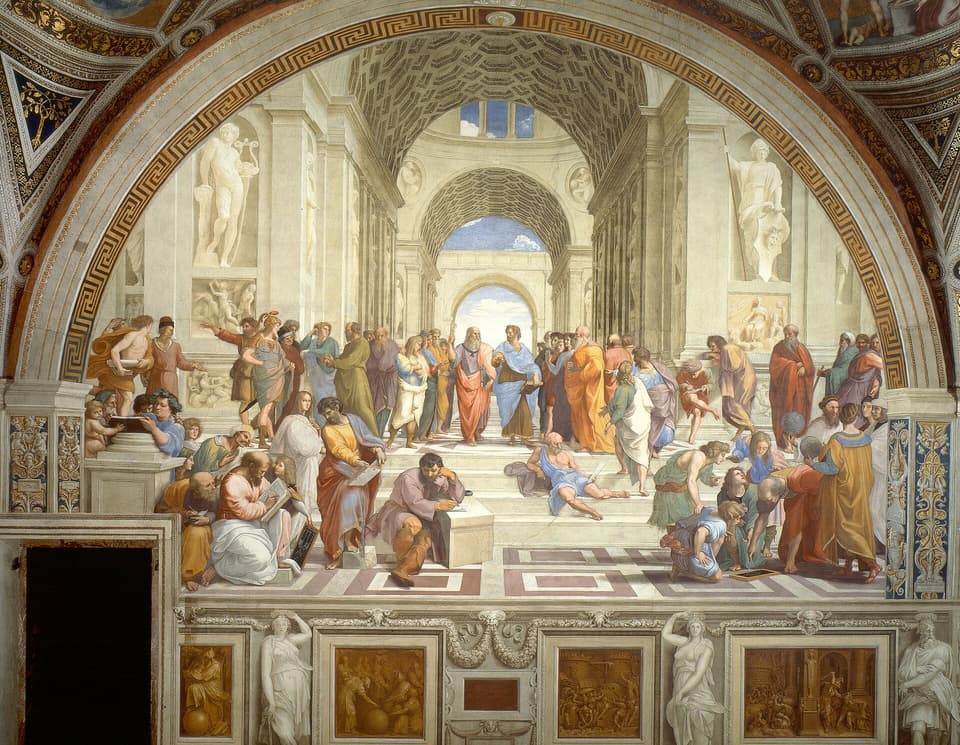
The School of Athens (1509–1511), Fresco in the Stanza della Segnatura, Apostolic Palace, Vatican City
The painting functions around a masterclass in linear perspective and intellectual contrast:
- Plato and Aristotle at the Vanishing Point: In the center, Plato (bearing the likeness of Leonardo da Vinci) points upward toward the realm of ideal forms, holding his Timaeus. Beside him stands his pupil Aristotle, holding the Nicomachean Ethics with his palm outstretched toward the earth, emphasizing empirical observation and the material world.
- The Classical Split: Thinkers concerned with abstract, celestial realms (such as Pythagoras and Parmenides) are grouped on Plato's left beneath a statue of Apollo; those concerned with practical mechanics and geometry (like Euclid, modeled after Bramante) gather on Aristotle's right beneath Athena/Minerva.
- The Michelangelo Addition: Slumped in deep contemplation on the steps is Heraclitus. Technical analysis reveals that Raphael added this figure late in the fresco's execution (late 1511). Having caught an early glimpse of Michelangelo’s half-completed Sistine Chapel ceiling next door, Raphael deliberately adopted Michelangelo’s heavy, sculptural chiaroscuro and gave the brooding pre-Socratic thinker Michelangelo’s likeness as an homage.
- The Artist's Signature: In the far lower right corner, standing next to Ptolemy, Raphael painted himself in a dark cap, looking directly at the viewer—an iconic self-portrait that serves as an anchor for art historians.
The Mass at Bolsena (1512): The Triumph of Venetian Color and Geometry
Located in the adjoining Stanza di Eliodoro, The Mass at Bolsena demonstrates Raphael’s rapid stylistic evolution toward heightened psychological realism and warmer, richer tonalities.
The fresco depicts a 1263 event at the town of Bolsena: a Bohemian priest who privately questioned the doctrine of transubstantiation (whether the bread and wine literally become Christ’s body and blood) witnessed the communion wafer bleed onto the corporal cloth during consecration. The miracle led directly to Pope Urban IV establishing the Feast of Corpus Christi in 1264.
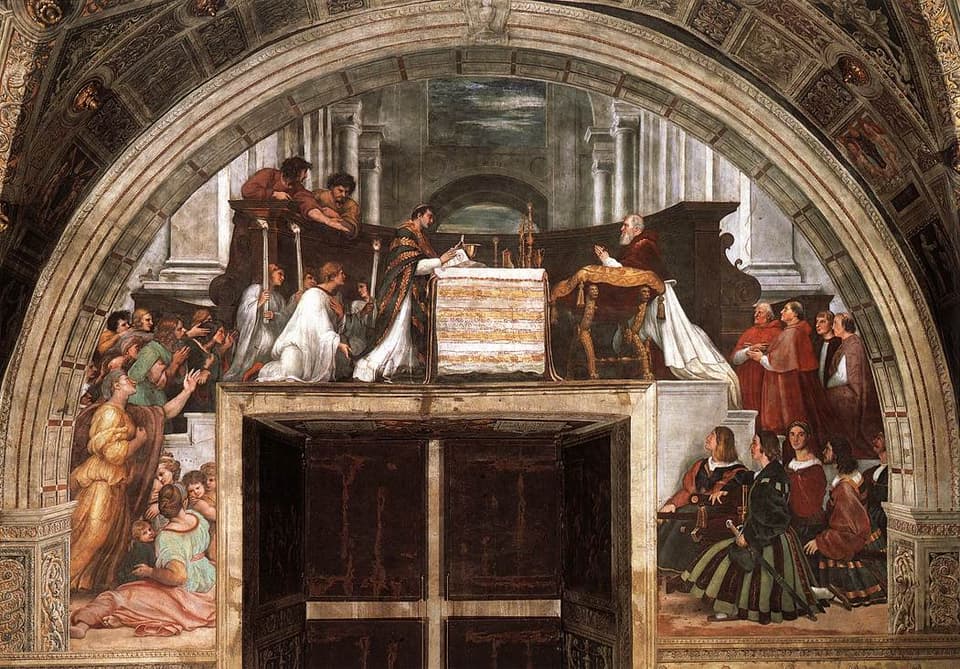
The Mass at Bolsena (1512), Fresco in the Stanza di Eliodoro, Apostolic Palace, Vatican City
When viewing or identifying this piece, several artistic achievements stand out:
- Mastering an Asymmetric Wall: Raphael faced a difficult architectural obstruction: a large window pierced through the wall off-center. Instead of fighting it, Raphael designed an elevated wooden choir platform above the window opening, placing the altar at the apex. The steps of the altar naturally terrace downward along both sides of the frame.
- Temporal Fusion (1263 Meets 1512): On the left side of the altar, the historical event unfolds—the startled Bohemian priest leans forward in shock as blood seeps onto the linen. On the right side, Raphael collapses three centuries of time: Pope Julius II kneels in calm, unwavering certainty, accompanied by his cardinals and attendants.
- The Swiss Guard Portraits: Below the papal bench, the papal Swiss Guard kneel with poise. Here, Raphael applied the luminous glaze techniques pioneered by Venetian masters like Sebastiano del Piombo, rendering deep velvets, crimsons, and metallic armors. Among the guards looking out at the viewer is another self-portrait of Raphael.
Comparative Analysis: How Raphael’s Style Shifted Between the Two Rooms
Spotting Raphael in Art Identification
When examining frescoes from the Italian High Renaissance, identifying Raphael comes down to his treatment of gesture and space. While Michelangelo emphasized muscular tension and Leonardo leaned into smoky contours (sfumato), Raphael constructed ordered, rhythmic choreographies where every gaze and hand gesture links one figure to the next. Whether observing philosophers debating on marble steps or Renaissance guards witnessing a medieval miracle, the signature of the Stanze is unity amid complexity.