 ArtGuess.io
Thangka: The Sacred Scroll Paintings of the Himalayas Arrive in ArtGuess.io
By Bruno, Founder of ArtGuess.io
• 5 min read
Our latest update adds 23 paintings to ArtGuess.io, but one group stands apart from everything else in the collection: the game's first thangkas, Buddhist paintings from Tibet, Bhutan and Mongolia. Nothing else in the game looks quite like them, and they put a whole new region on the map: the high Himalayas and the steppes of Central Asia.
What Is a Thangka?
A thangka (also spelled tangka or thanka) is a Buddhist painting on cotton or silk, usually mounted in a frame of silk brocade so that it can be rolled up like a scroll. That portability mattered: thangkas could travel with monks and pilgrims, be carried between monasteries, and be unrolled for teaching, meditation and ceremonies.
A thangka is not simply a picture. It is a religious object, made to help the viewer visualise a buddha, a teacher or a sacred story, and it is often consecrated before use. Painters followed strict rules of proportion, laid out on a grid, so that every figure appears in its correct form, with the right colours, hand gestures and attributes. They worked with mineral and plant pigments and often gold, and many of them were monks who regarded painting as a devotional practice rather than a personal art. That is why so many thangkas, including most of the ones in our collection, are anonymous.
Eight Centuries in Five Paintings
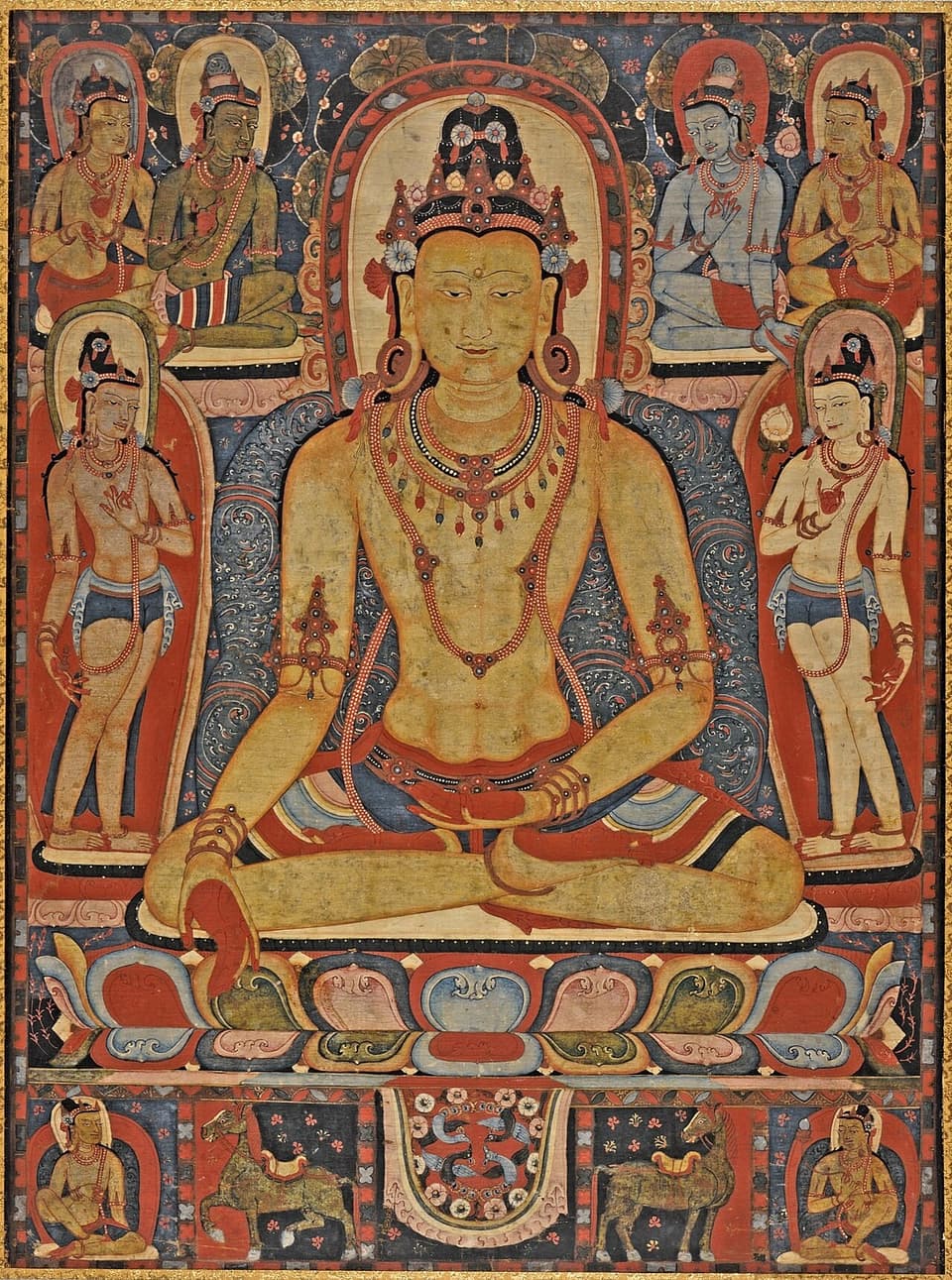
Jina Buddha Ratnasambhava (late 12th century), Central Tibet
The oldest of the new thangkas is this Ratnasambhava, painted in Central Tibet in the late twelfth century. Ratnasambhava is one of the five "Jina" or cosmic buddhas, associated with generosity, and his right hand points down in the gesture of giving. He is crowned and jewelled, and he is surrounded by attendant bodhisattvas, with his symbolic mount, the horse, in the panels below. The warm red background, the gold-toned skin and the symmetrical layout show the strong influence of painting from the Pala kingdoms of eastern India and from Nepal, the sources from which Tibetan Buddhist art first developed.
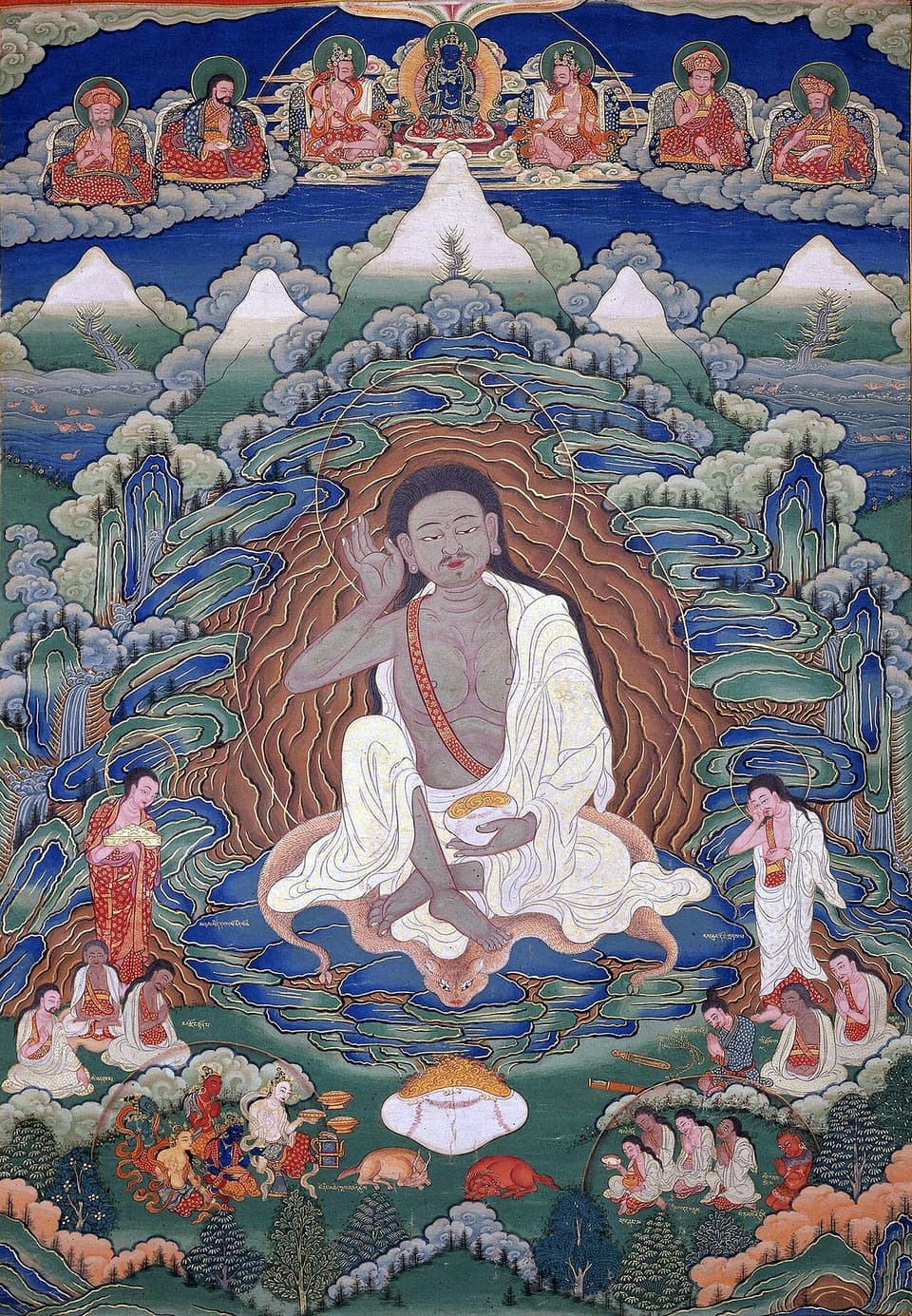
Milarepa (late 19th century), Bhutan
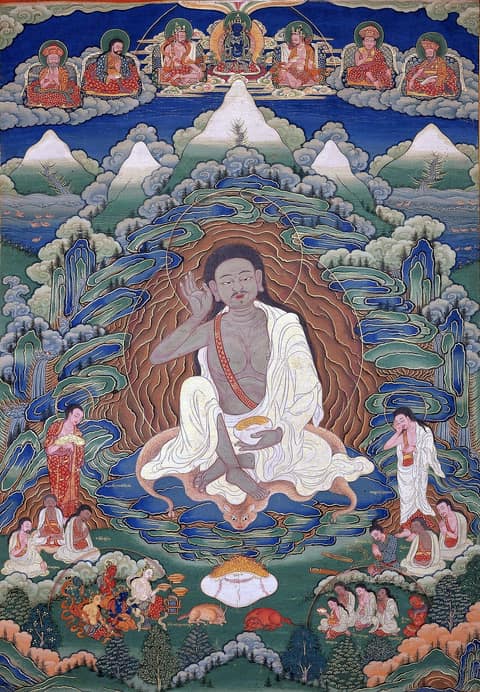
Seven hundred years later, Bhutanese painters were still at work, but the style had changed. This thangka shows Milarepa, the eleventh-century yogi and poet who is one of the most beloved figures in Tibetan Buddhism. He sits in a white cotton robe with his hand cupped to his ear, the classic gesture of a singer, because he taught through spontaneous songs. Around him, the setting has become a landscape of snowy peaks, blue-green hills, curling clouds and pine trees, an approach that later Himalayan painters absorbed from Chinese landscape painting.
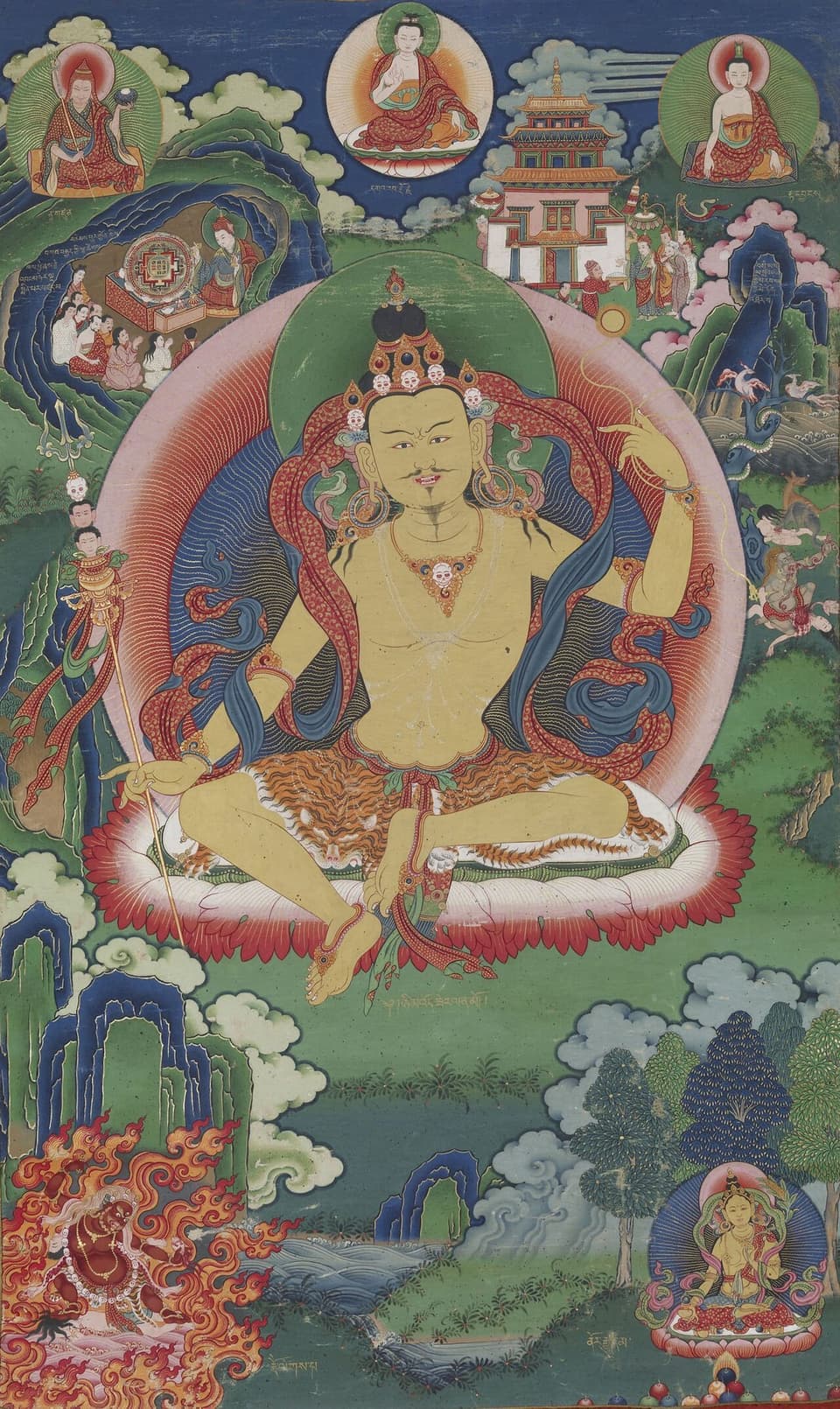
Guru Nyima Özer (late 19th century), Bhutan
Guru Nyima Özer ("Guru Sun Rays") is one of the eight manifestations of Padmasambhava, the teacher credited with bringing Buddhism to Tibet and Bhutan and still revered as a second Buddha in Bhutan. Here he appears as a wild yogi on a tiger skin, holding a ritual staff and seeming to catch the rays of the sun. Our collection also includes a Bhutanese painting of the Jataka tales, the stories of the Buddha's previous lives, arranged in small scenes around a central seated Buddha.
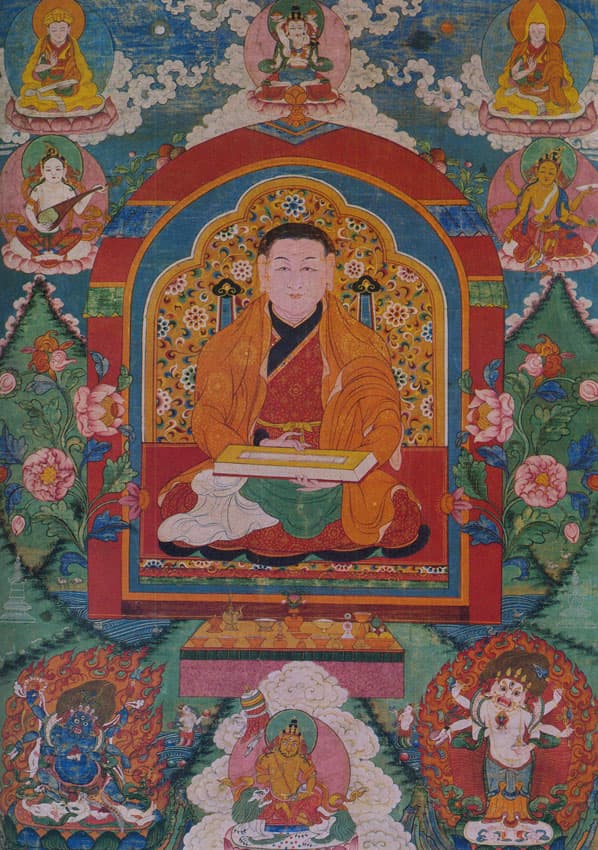
Self-portrait of Zanabazar (c. 1680), Övörkhangai, Mongolia
The fifth painting takes us north to Mongolia. Zanabazar (1635–1723) was the first great spiritual leader of Mongolian Buddhism, and also one of the finest artists of his age, celebrated above all for his gilded bronze sculptures. This portrait, traditionally described as his self-portrait, shows him enthroned in monastic robes, surrounded by buddhas, protectors and flowering trees. It is associated with the Övörkhangai region, where Zanabazar built his mountain retreat.
Why Thangkas Make Great Rounds
At first sight, thangkas from Tibet, Bhutan and Mongolia can look alike: the same deities, the same symbols, the same rich colours. That is what makes them such a good test. A few clues will help you place them:
- Flat red backgrounds and rows of figures suggest an early Tibetan work, closer to its Indian and Nepalese roots.
- Green landscapes, swirling clouds and blue-green rocks point to later Himalayan painting, especially from the eighteenth and nineteenth centuries. Bhutan is a strong candidate.
- Padmasambhava and his manifestations are especially popular in Bhutan.
- A realistic portrait of a monk-ruler surrounded by buddhas may take you north, to Mongolia.
Also New in This Update
The thangkas are part of a wider batch of 23 paintings. It includes Buddhist court painting from Myanmar; Japanese masters such as Sesshū, Hasegawa Tōhaku, Itō Jakuchū and Nagasawa Rosetsu; the game's first Serbian paintings, by Paja Jovanović, Uroš Predić and Nadežda Petrović; two works from the Cusco School of colonial Peru; Mantegna and Domenichino from Italy; and a bird study by the Chinese painter Huang Quan, which, at around 950, is now the oldest painting in ArtGuess.io. The full list of changes is on the What's New page.
Try it yourself: Set the region filter to Asia to meet the new thangkas, or read our post on Persian miniatures and Ethiopian murals for more of the game's devotional and courtly traditions.