 ArtGuess.io
35 New Paintings: Persian Miniatures, Ethiopian Murals and Colonial Mexico Join ArtGuess.io
By Bruno, Founder of ArtGuess.io
• 9 min read
A good round of ArtGuess.io makes you look harder than you normally would: at the shape of a turban, the colour of a sky, the way a painter handles a face. That only works if the collection is varied enough to surprise you. So before adding this latest batch, we took a hard look at where the map was thin.
The answer was clear. The game had almost nothing from the Persian and Ottoman worlds, only one painting from Africa made before 1900, a single work from colonial Latin America, and surprisingly few of the early Italian Renaissance masters. This update tackles all four. It adds 35 paintings by 24 new artists, including the game's first works from Iran, Turkey, Afghanistan, Uzbekistan, Portugal, Colombia and Argentina.
Here is a tour of the new arrivals, and why each group makes the game better.
The Persian Miniature: From Herat to Isfahan
Persian painting is one of the great traditions of world art, and until now it was completely missing from the game. For centuries Persian artists worked mainly on a small scale, illustrating manuscripts of poetry and history with jewel-like colour, gold and astonishingly fine brushwork. Because the tradition moved with its royal patrons from city to city, it is also a wonderful geography puzzle.
Behzād in Herat
At the end of the fifteenth century the most celebrated painter in the Persian world was Kamāl ud-Dīn Behzād, who worked in Herat, today in western Afghanistan, at the court of the Timurid ruler Sultan Husayn Bayqara. Earlier painters had arranged their figures like neat, symmetrical patterns. Behzād filled his scenes with individual people doing individual things.
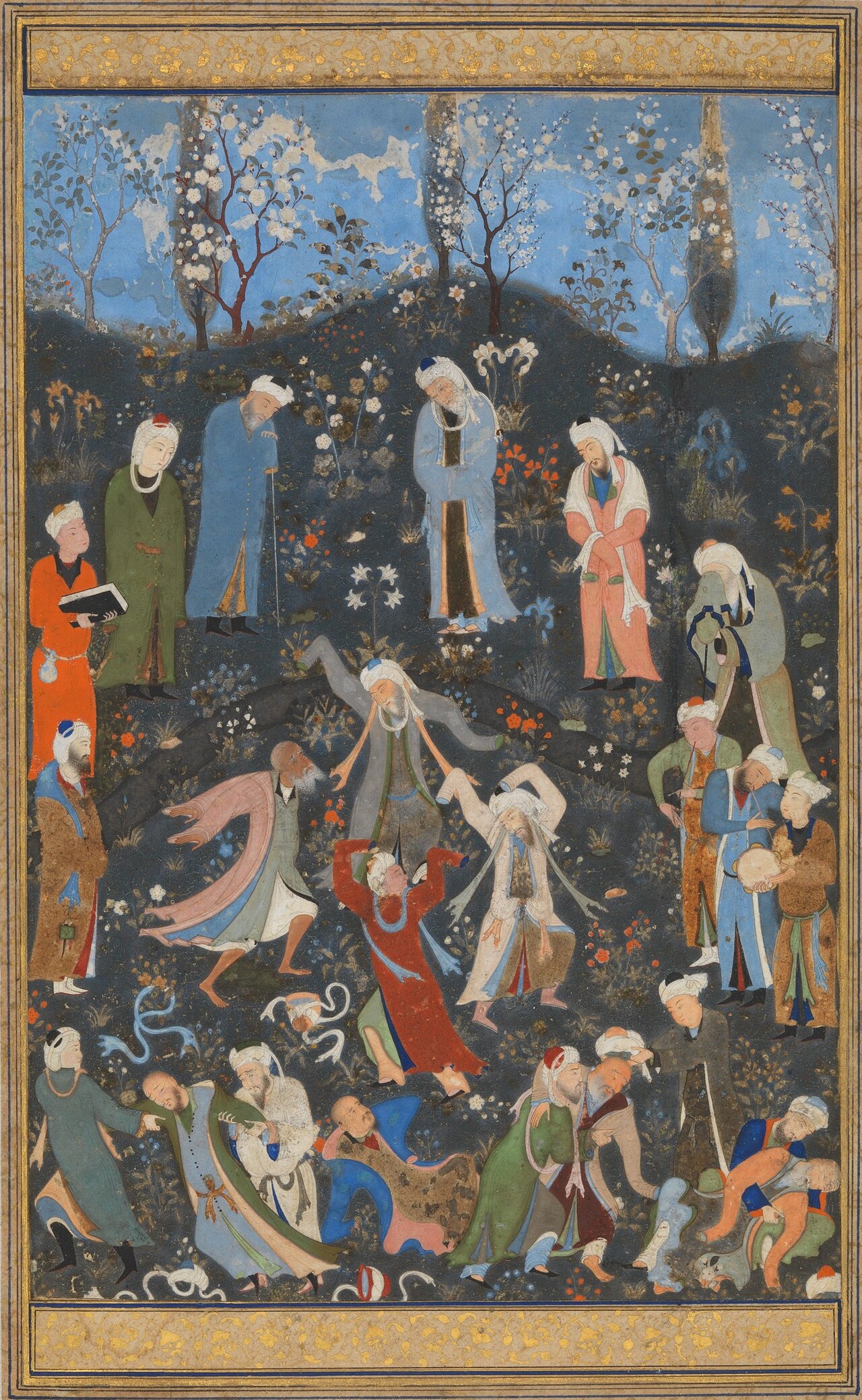
Dancing Dervishes (c. 1485), Kamāl ud-Dīn Behzād, Herat
Dancing Dervishes shows exactly what made him famous. Sufi mystics whirl, collapse and clutch one another in ecstasy in a flowering garden, while musicians play and onlookers watch quietly from the hillside. No two figures are the same. Look at the dark, flower-scattered ground and the spring trees against a lapis-blue sky: these are hallmarks of the Herat school.
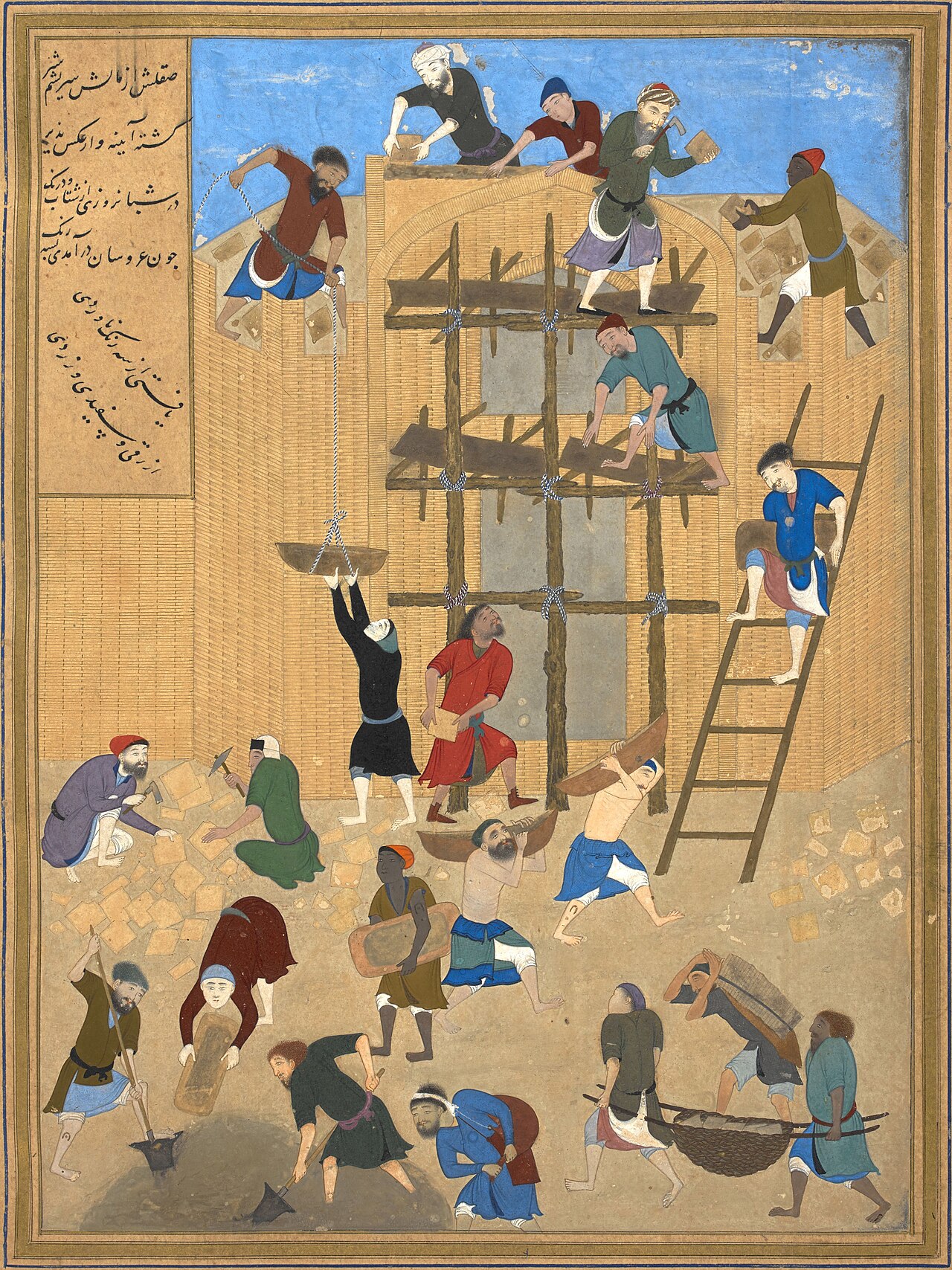
The Construction of the Castle of Khawarnaq (1494), Kamāl ud-Dīn Behzād, Herat
The Construction of the Castle of Khawarnaq illustrates a story from the poet Nizami about a legendary palace. Yet Behzād barely shows the palace at all. Instead he paints the building site: men hauling bricks up on ropes, mixing mortar, climbing ladders and balancing on wooden scaffolding, each one absorbed in his own task. Hardly any earlier Persian painting looked so closely at ordinary working people, and it is one of the reasons Behzād is still considered the greatest master of the tradition.
Bukhara and Shiraz
When Herat fell in the early sixteenth century, its artistic tradition did not disappear; it travelled. In Bukhara, in present-day Uzbekistan, the court of the Shaybanid khans kept the Herat style alive for decades. Visit to a Dervish by Mahmud Muzahhib shows a king and his courtiers calling on a holy man who sits in a cave, beneath a huge plane tree blazing with autumn leaves. The crowded composition, the jewel-coloured rocks and the elegant figures all descend directly from Behzād.
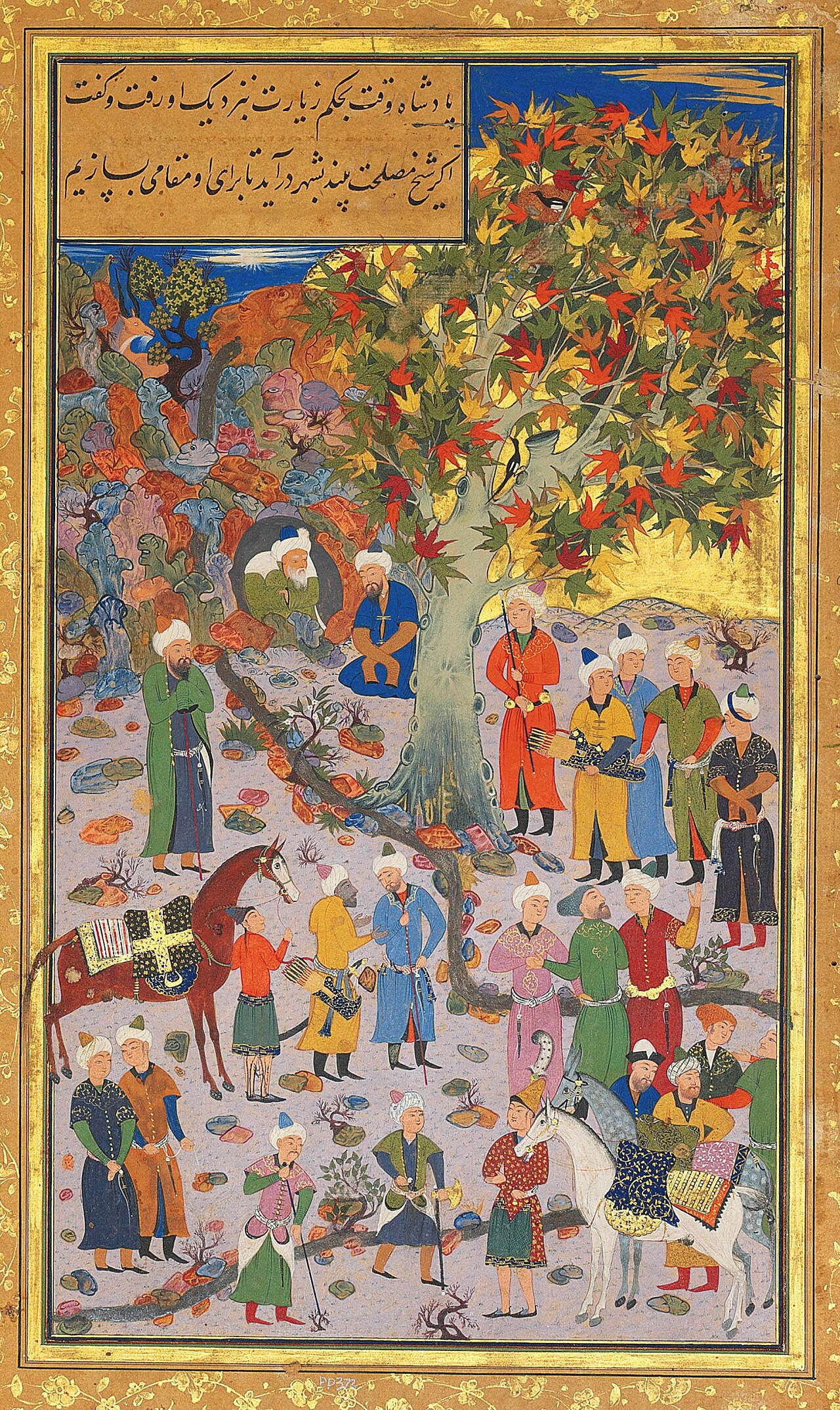
Visit to a Dervish (c. 1560), Mahmud Muzahhib, Bukhara
Far to the south, Shiraz was the great commercial centre of Persian book production, turning out illustrated manuscripts for buyers across the Islamic world. Khusraw Discovers Shirin (1548) shows one of the best-loved scenes in Persian poetry: the prince Khusraw, riding through the countryside, comes upon Shirin bathing in a stream and raises a finger to his lips, the traditional gesture of astonishment in Persian painting. Its bold, simplified landscape and text panels set into the picture are typical of Shiraz work.
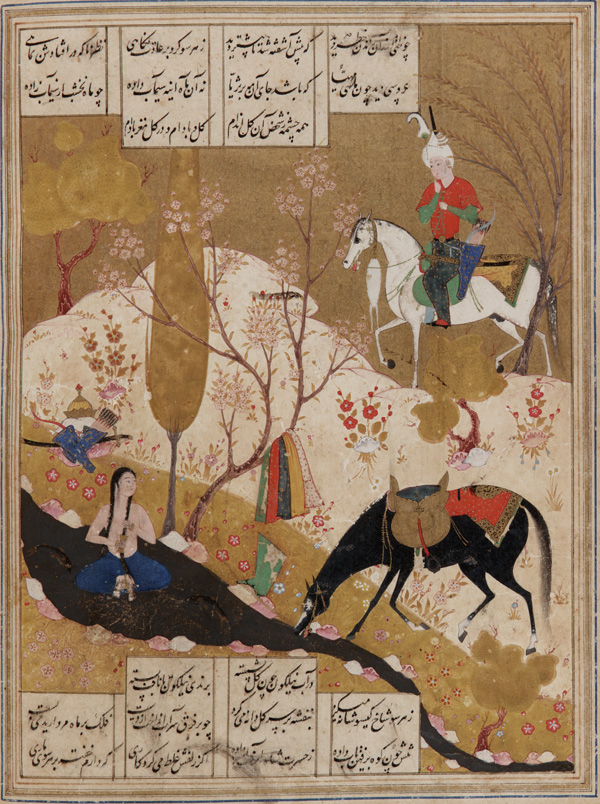
Khusraw Discovers Shirin (1548), Murshid al-Shirazi, Shiraz
Reza Abbasi in Isfahan
A century later, the Safavid ruler Shah Abbas I made Isfahan his capital and filled it with mosques, palaces and gardens. Its leading painter, Reza Abbasi, changed Persian painting again. Instead of crowded manuscript illustrations, he produced single-page portraits of elegant courtiers, made to be collected in albums.
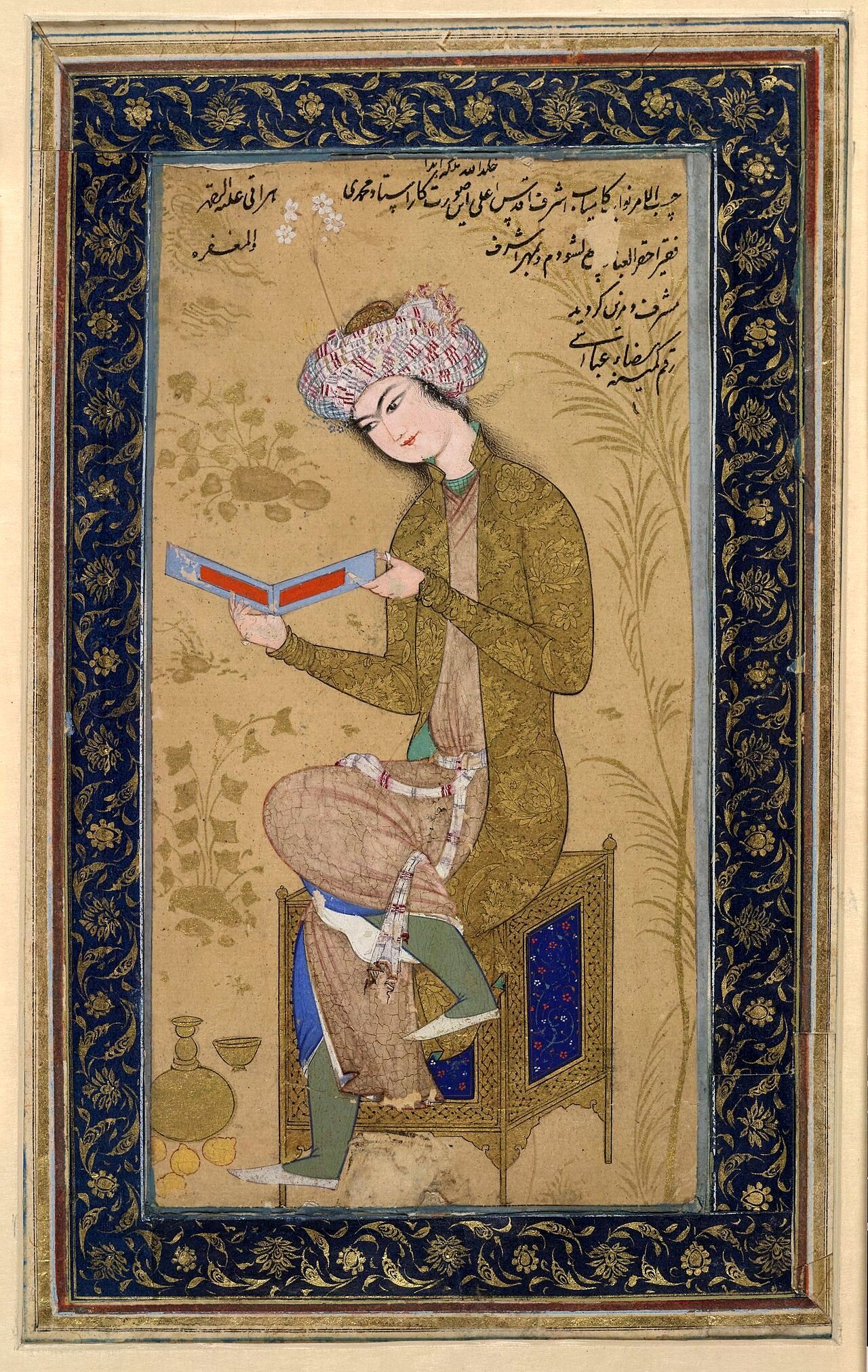
Youth Reading (c. 1625), Reza Abbasi, Isfahan
Youth Reading is a perfect example: one languid young man in a gold-patterned coat and a striped turban, perched on a stool, absorbed in a book. The swelling, calligraphic outline of his robe and the sparse gold plants behind him are signatures of the Isfahan style. The new collection includes three works by Reza Abbasi, along with two by Sadiqi Beg, the fiery head of the royal library who worked in Qazvin, the Safavid capital before Isfahan.
Why they're great for the game: Persian miniatures look alike at first glance, but the details give them away. Crowded, lively scenes suggest Timurid Herat or its heir, Bukhara; single elegant figures with sweeping outlines suggest Safavid Isfahan; bold, simplified landscapes with text panels often point to Shiraz. Learning that difference is the kind of close looking ArtGuess.io is built for.
Ottoman Istanbul: From Astronomers to Tortoises
The Ottoman court in Istanbul developed its own school of miniature painting, with a very different feel from the Persian one: bolder colours, flatter spaces and a love of documenting real events.
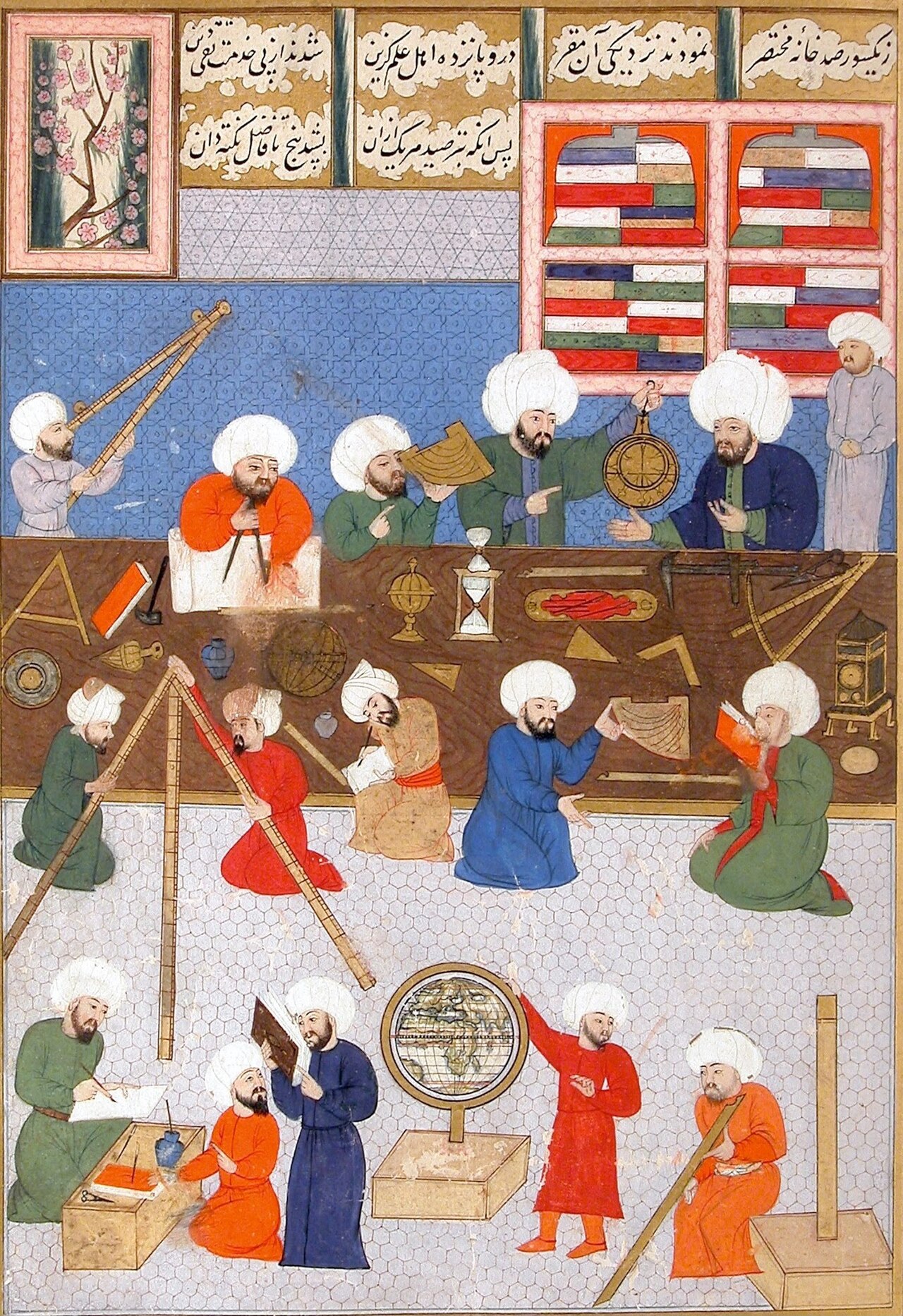
Taqī al-Dīn and the astronomers of the Istanbul observatory (c. 1581), attributed to Nakkaş Osman, Istanbul
This painting records the observatory built in Istanbul in 1577 by the astronomer Taqī al-Dīn. His team is shown at work with astrolabes, quadrants, a sand-glass, a mechanical clock and a globe, while scholars take notes. It is a rare picture of science in the sixteenth-century Islamic world, and one of the most famous Ottoman miniatures. The observatory itself was torn down only a few years after it opened.
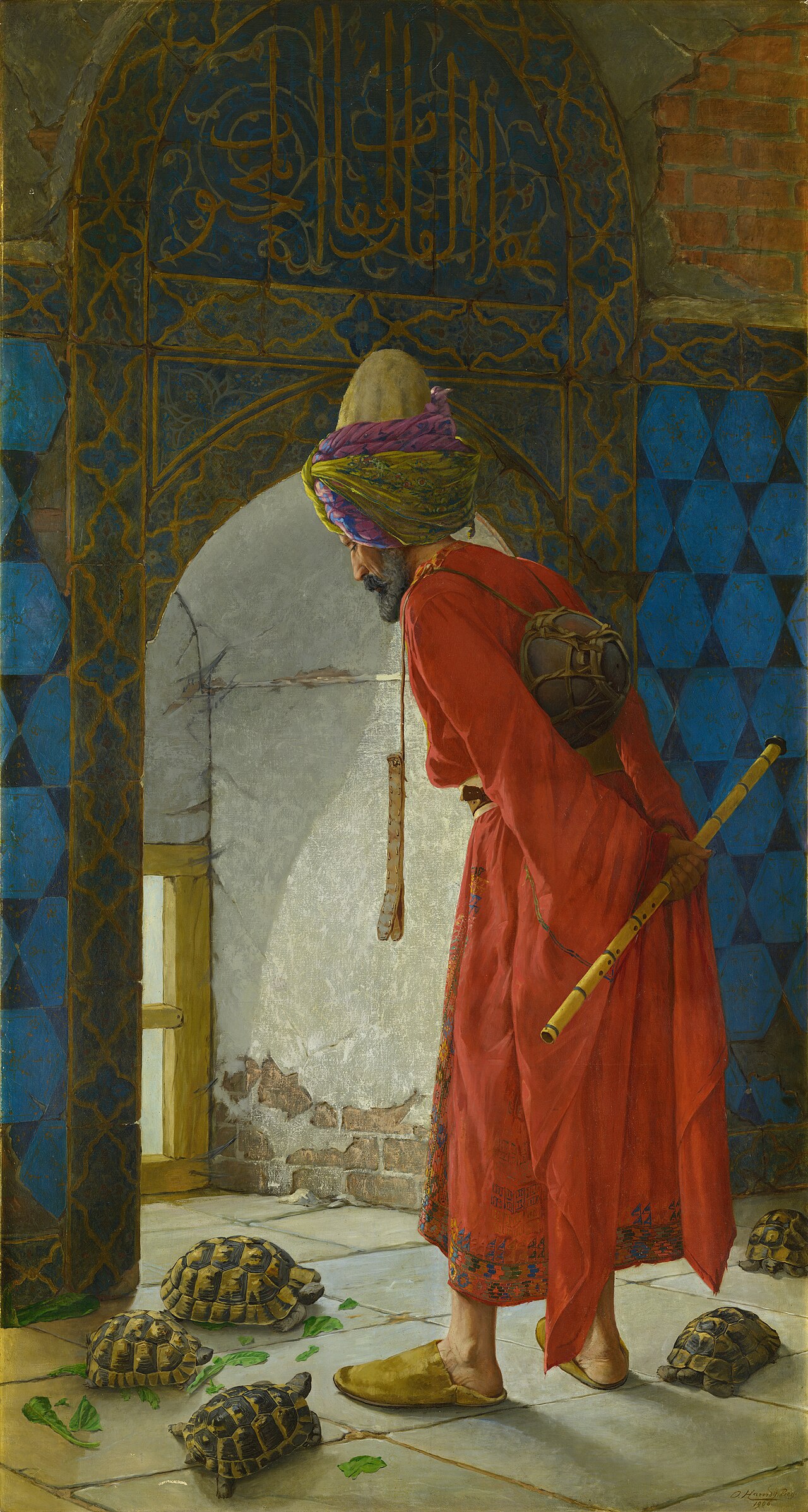
The Tortoise Trainer (1906), Osman Hamdi Bey, Istanbul
Three centuries later, Osman Hamdi Bey painted The Tortoise Trainer, now one of the most beloved paintings in Turkey. Osman Hamdi trained in Paris, then returned to found Istanbul's archaeology museum and its first academy of fine arts. Here an elderly man in a red robe, with a flute behind his back, patiently tries to train a group of tortoises in front of tiled walls. Many viewers read it as a gentle joke about the slow pace of reform in the late Ottoman Empire. It is a great addition because it looks, at first, like a European Orientalist painting, yet it was painted by an Ottoman artist in Istanbul.
Ethiopian Church Painting
Ethiopia has one of the oldest Christian traditions in the world and a painting style found nowhere else. Its churches are covered from floor to ceiling in brightly coloured murals of saints, angels and Bible stories, painted in a style that changed remarkably little over centuries.
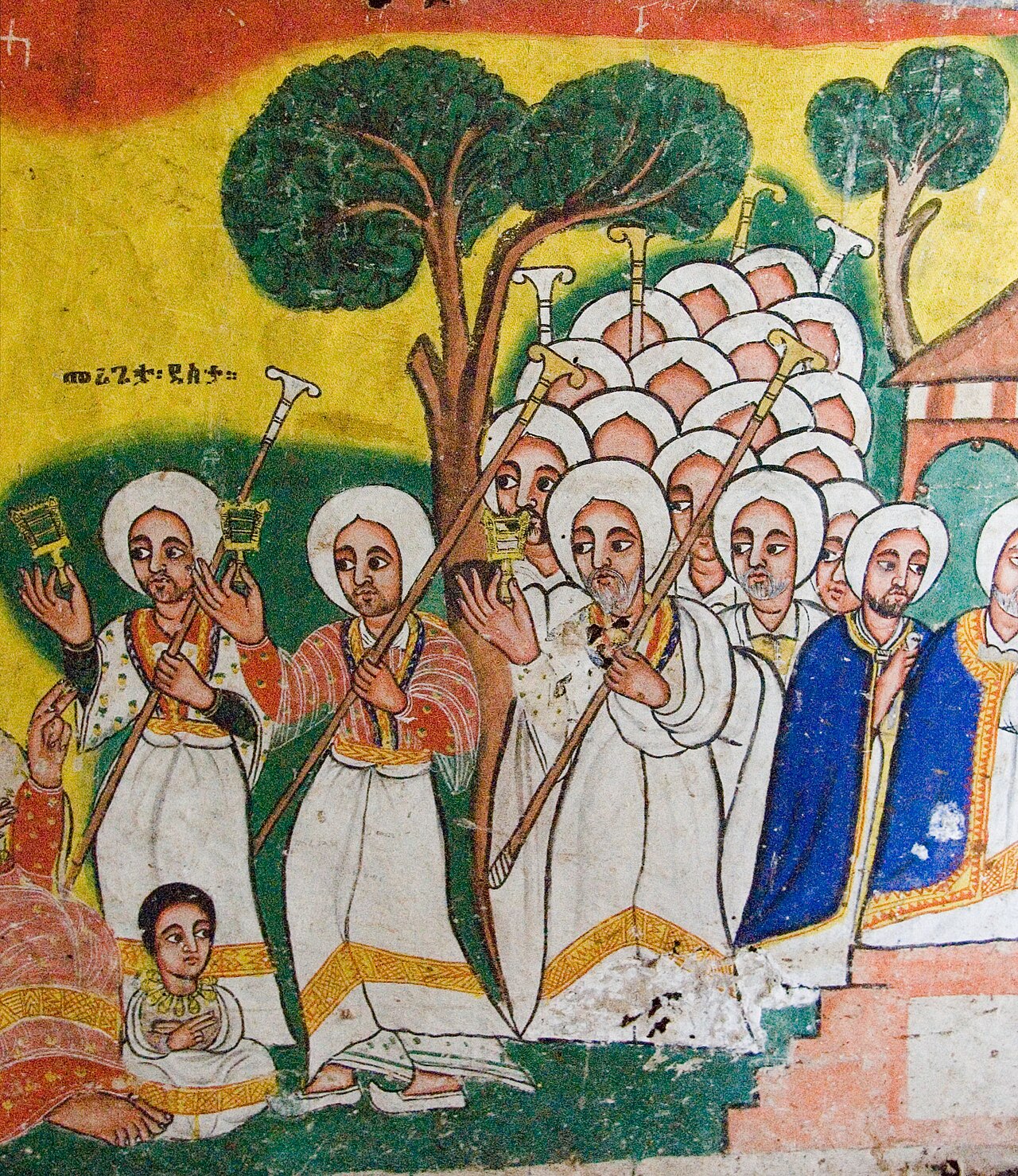
Mural in the Church of Ura Kidane Mihret, Zege Peninsula, Lake Tana
The round church of Ura Kidane Mihret stands in the forest on the Zege Peninsula, on Lake Tana in northern Ethiopia. In this section of its murals, a procession of clergy in white robes with yellow borders carries processional crosses and long staffs. The figures face us with huge almond-shaped eyes, set against flat bands of yellow, green and red, with labels written in the Ge'ez script.
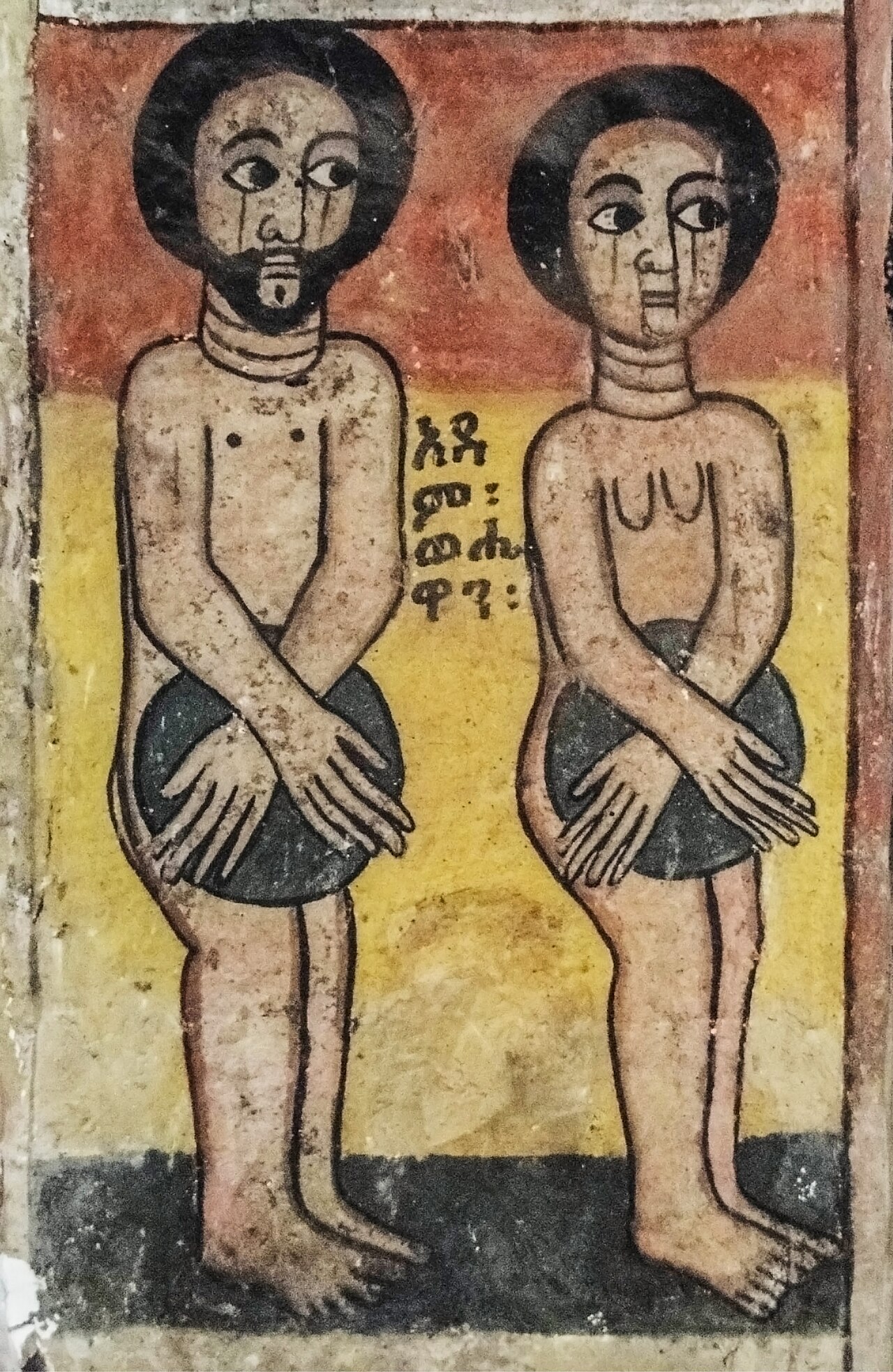
Adam and Eve (c. 1870), anonymous painter, Wukro, Tigray
This much simpler painting from a church near Wukro, in the Tigray region, shows Adam and Eve weeping after their fall, with black tears running down their faces. It shows the same conventions: frontal figures, enormous eyes, strong outlines and bands of colour. For players, these paintings are instantly recognisable once you have seen a few, and they put a whole new region of Africa on the map.
Colonial Latin America: The Art of New Spain
Between the 1520s and 1821, Mexico was the heart of the Spanish viceroyalty of New Spain, and Mexico City was home to some of the busiest painting workshops in the Americas. The game now includes seven colonial works, mostly from Mexico City, by painters such as Juan Correa, Miguel Cabrera, José Vivar y Valderrama and José de Páez, plus Gregorio Vázquez de Arce y Ceballos from Bogotá, the leading painter of colonial New Granada.
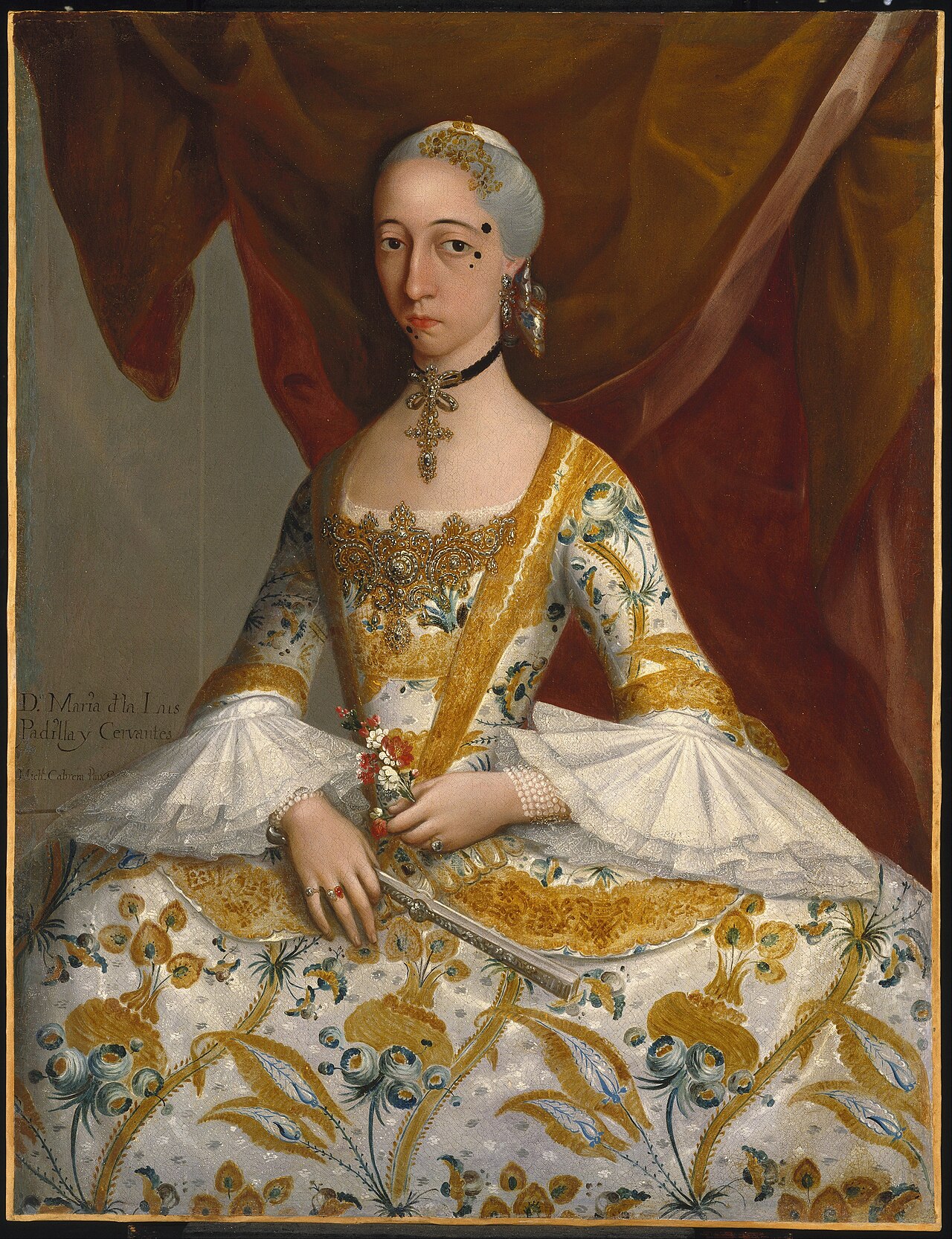
Doña María de la Luz Padilla y Gómez de Cervantes (c. 1760), Miguel Cabrera, Mexico City
Miguel Cabrera was the most sought-after painter in eighteenth-century Mexico. His portrait of Doña María de la Luz Padilla shows the wealth of colonial society: a silk gown embroidered with flowers, lace sleeves, pearls, a jewelled cross and small black beauty patches on her face, a fashion of the day. Paintings like this can easily be mistaken for Spanish portraits, which is exactly what makes them a good test.
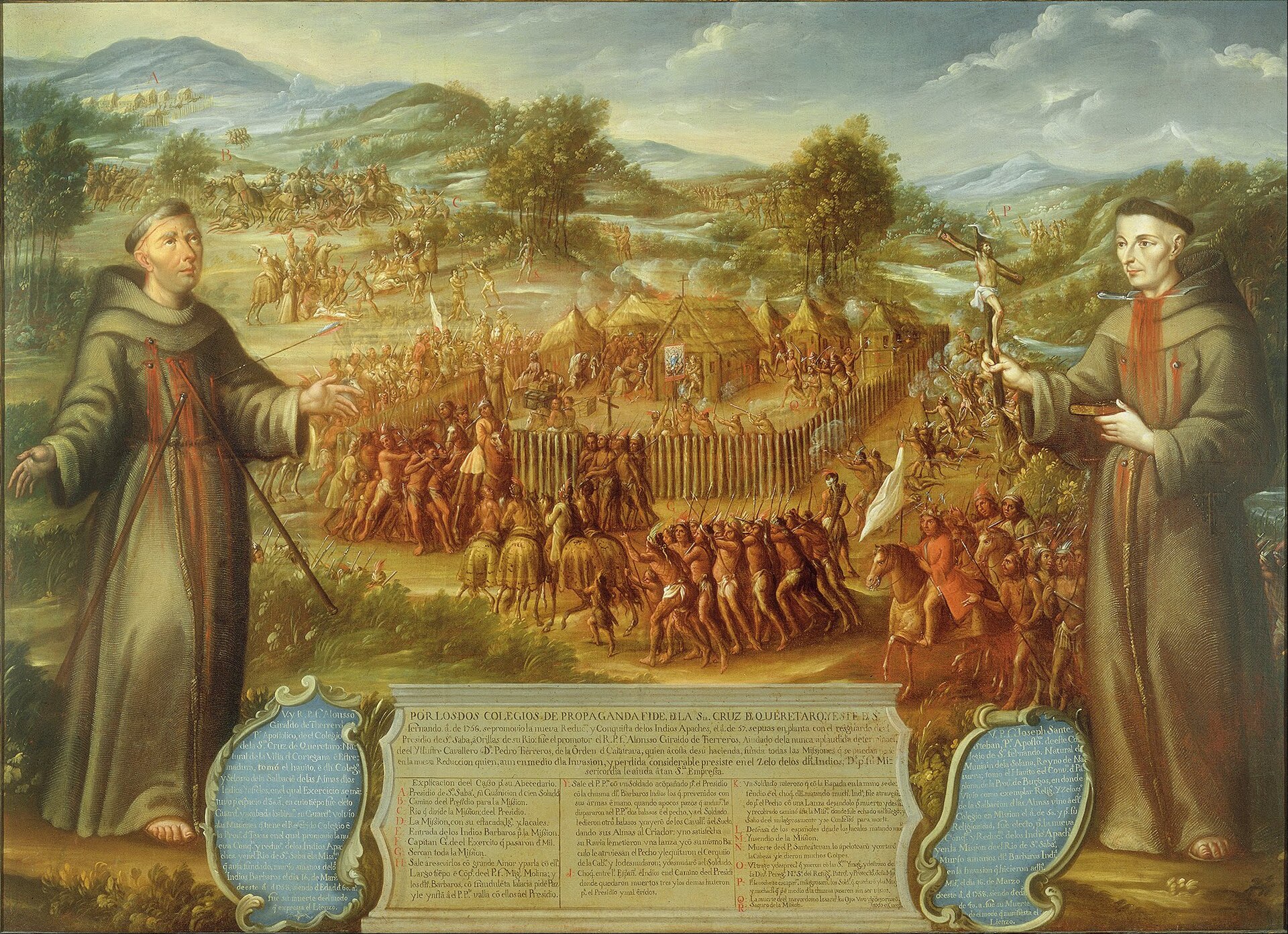
The Destruction of the Mission of San Sabá in the Province of Texas (c. 1765), José de Páez, Mexico City
José de Páez's enormous canvas records the attack on the Mission of San Sabá in Texas in 1758, with two Franciscan martyrs on either side and a lettered key at the bottom explaining each scene. It is one of the earliest paintings of an event in Texas history. But it was painted in Mexico City, so that is where your pin should go.
Two later Latin American works stand out too. Francisco Goitia's Zacatecas Landscape with Hanged Men II (1914) was painted while he travelled with revolutionary forces during the Mexican Revolution, and it is as bleak as its title. Ernesto de la Cárcova's Without Bread and Without Work (1894), painted in Buenos Aires, shows an unemployed worker and his family looking out at a silent factory, and is often called Argentina's first great social-realist painting.
Portugal and the Early Italian Renaissance
The batch also adds the game's first paintings from Portugal: works by Vasco Fernandes, known as Grão Vasco, from the cathedral city of Viseu; Gaspar Dias of Lisbon; the Romantic painter Domingos Sequeira; Alfredo Roque Gameiro; and the modernist José Tagarro.
From Italy come five cornerstones of early Italian painting: Giotto's monumental Ognissanti Madonna (c. 1310), painted for the church of Ognissanti in Florence, whose solid, weighty figures pointed the way to the Renaissance; Piero della Francesca's serene Baptism of Christ, painted for his home town of Sansepolcro; the Baptism of Christ by Andrea del Verrocchio, in which his young pupil Leonardo da Vinci painted one of the angels; Giovanni Bellini's Agony in the Garden from Venice; and Sandro Botticelli's Venus and Mars from Florence.
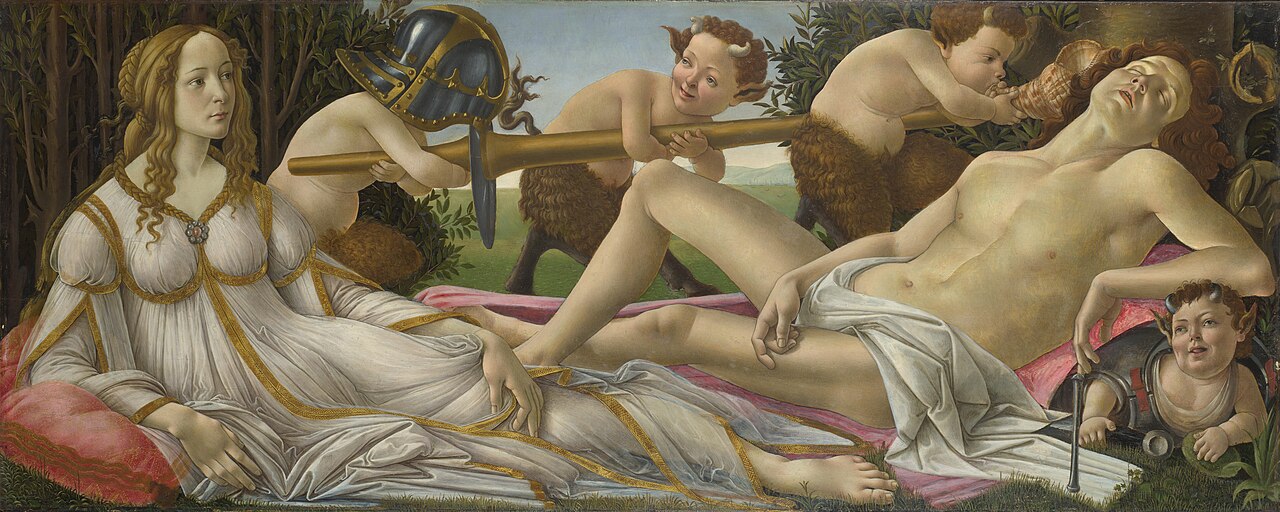
Venus and Mars (c. 1485), Sandro Botticelli, Florence
These are paintings many players will know, which is a feature, not a bug. They give newcomers an achievable round, and they make a useful contrast with the miniatures: both traditions were flourishing at exactly the same time, in the 1480s, a few thousand kilometres apart.
Four New Geographic Traps
Some of the best rounds in ArtGuess.io are paintings that depict one place but were made somewhere else entirely. This batch adds several of them:
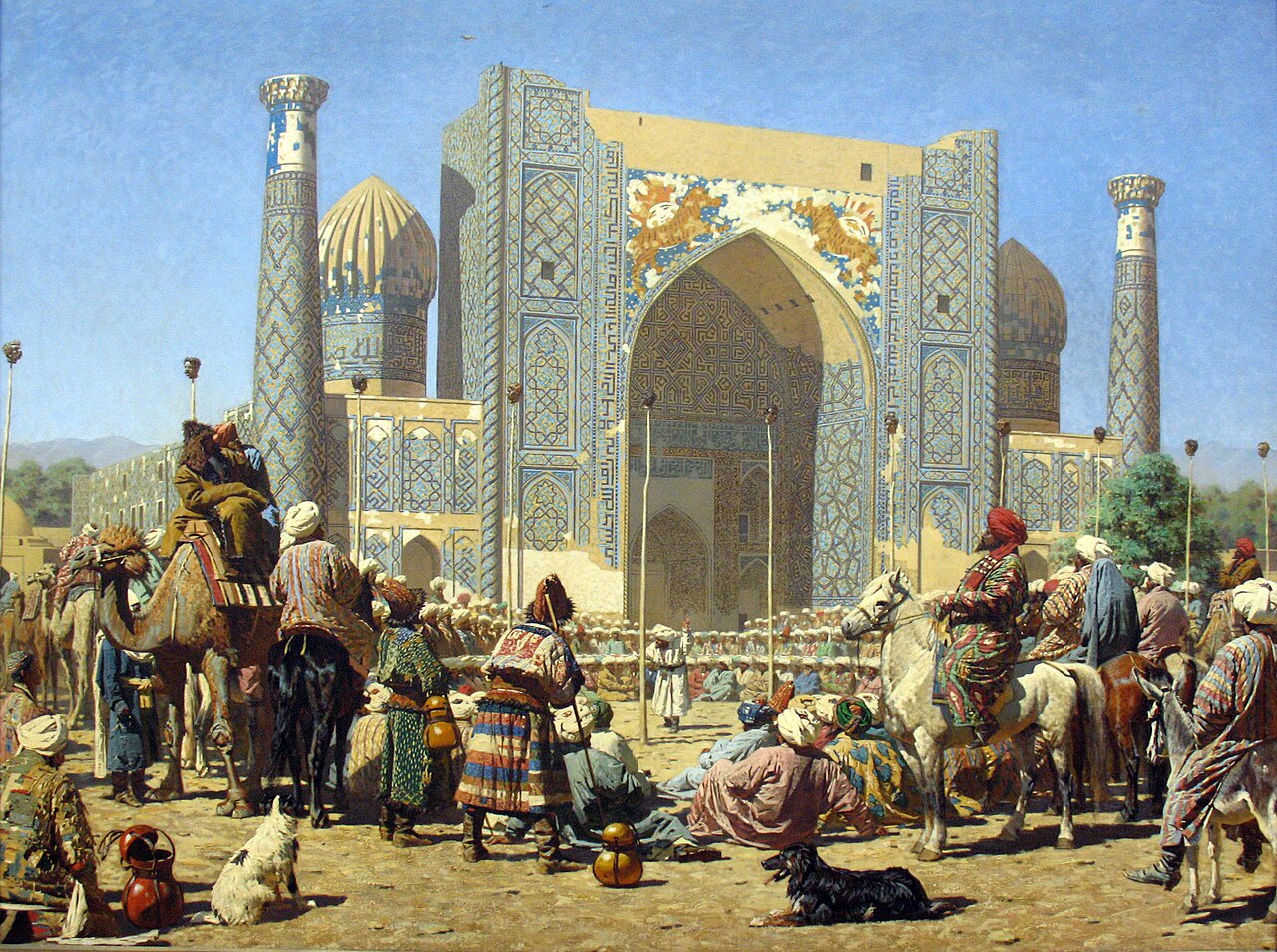
They Are Triumphant (1872), Vasily Vereshchagin, painted in Munich
- Vasily Vereshchagin, They Are Triumphant: The blue-tiled Sher-Dor Madrasa on the Registan in Samarkand dominates the scene, and a crowd gathers in the square. But Vereshchagin painted his famous Turkestan series back in his Munich studio, from sketches made on campaign. Pin Germany, not Uzbekistan.
- José de Páez, The Destruction of the Mission of San Sabá: A Texas subject, painted in Mexico City.
- Alfredo Roque Gameiro, Vasco da Gama's Arrival in Calicut in 1498: An Indian setting, painted in Lisbon four centuries later.
- Domingos Sequeira, The Adoration of the Magi: A Portuguese painter, but this work was made in Rome, where he spent his final years.
Quick Clues for the New Paintings
- Gold borders, tiny figures, Persian script: a Persian or Timurid miniature. Busy, crowded scenes point to Herat or Bukhara; single elegant figures point to Isfahan.
- Bold flat colours, big white turbans, documentary scenes: Ottoman Istanbul.
- Huge almond eyes, frontal faces, Ge'ez lettering, yellow and red bands: Ethiopian church painting.
- European-looking Baroque portraits or religious scenes with inscription panels: think colonial Mexico City before you think Madrid.
Try them now: Set the region filter to Asia and the time period to the 15th–17th centuries to meet the new miniatures, or pick North America and the 17th–18th centuries for colonial Mexico. For everything else that has changed recently, see What's New.
With these additions ArtGuess.io now holds more than 400 paintings by over 200 artists. There are still gaps we want to fill, from the Cusco School of Peru to early Chinese scroll painting and British landscape painting, so expect more new arrivals soon. If there is a painting or tradition you would love to see in the game, let us know.