 ArtGuess.io
Hokusai and Hiroshige: Two Artists Who Mapped Edo-Period Japan
By Bruno, Founder of ArtGuess.io
• 8 min read
For more than two centuries, from 1603 to 1868, Japan was ruled from the city of Edo, today's Tokyo. The Tokugawa shoguns kept the country largely closed to foreigners, yet inside its borders people traveled, shopped, went to the theater and went on pilgrimages more than ever before. Edo grew into one of the largest cities in the world, and its townspeople wanted pictures of the world they lived in.
Two artists met that demand better than anyone: Katsushika Hokusai (1760–1849) and Utagawa Hiroshige (1797–1858). Between them they produced a visual atlas of Japan: its sacred mountain, its great highway, its neighborhoods, gods and merchants. Their work also reached Europe and changed how Monet, Degas and Van Gogh painted. ArtGuess.io has more than twenty of their works in its database, and this guide shows you how to recognize them and work out where they were made.
The Floating World: What "Ukiyo-e" Means
Both artists belong to the tradition of ukiyo-e, "pictures of the floating world." The term originally came from Buddhism, where ukiyo meant the sorrowful, impermanent world. By the late 17th century, Edo's townspeople had reread it as a celebration of fleeting pleasures: kabuki actors, fashionable courtesans, festivals and seasonal outings.
Most ukiyo-e were woodblock prints, made by a team rather than a single person:
- The designer (Hokusai or Hiroshige) drew the image in ink on thin paper.
- The carver pasted that drawing face-down onto a cherry-wood block and cut away everything except the lines, destroying the original drawing in the process.
- The printer inked a separate block for each color and pressed the paper onto them one by one, lining them up with registration marks called kentō.
- The publisher financed the project, chose the subjects and sold the prints from a shop in Edo, often for about the price of a bowl of noodles.
This system matters for location. Even when a print shows a village hundreds of kilometers away, it was designed, carved, printed and sold in Edo. That is why many Japanese works in ArtGuess are pinned to Tokyo.
Hokusai: The Old Man Mad About Painting
Hokusai was born in 1760 in the Katsushika district of Edo, which gave him the name he is best known by. He was anything but settled. He is said to have moved house more than ninety times and used over thirty different art names during a career of seventy years. He worked in almost every format available: book illustrations, privately commissioned New Year prints (surimono), landscapes, hanging scrolls and thousands of sketches.
His restless curiosity shows in the many brush drawings ArtGuess.io holds. Several of them show the popular deities of Edo's merchant class:
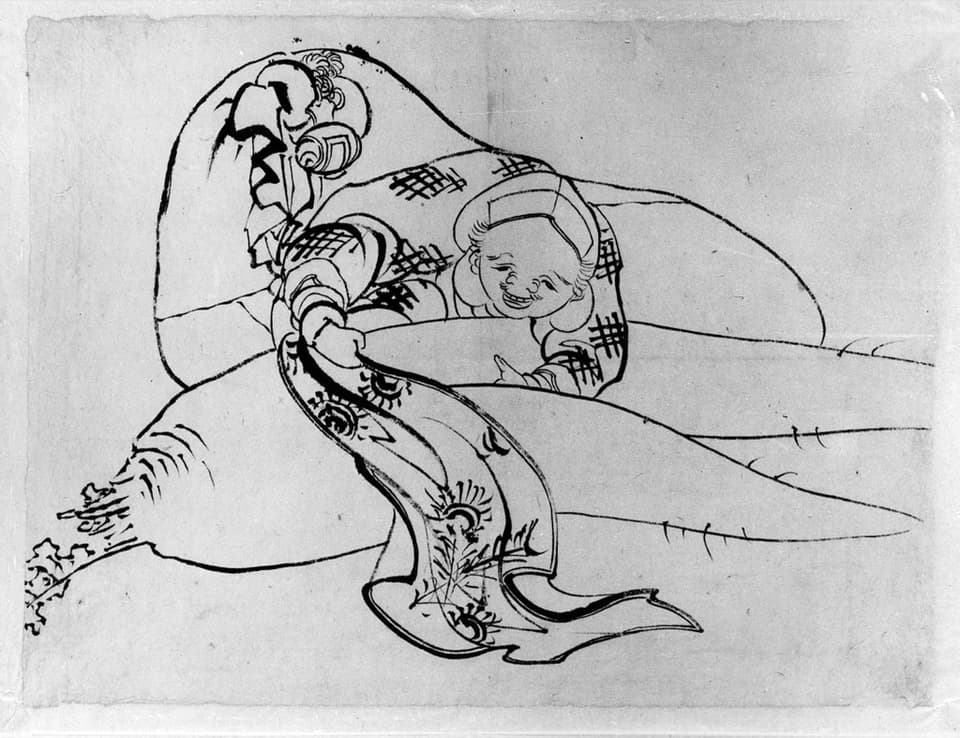
Daikoku (God of Luck) with Radish (1804), Katsushika Hokusai, ink drawing, Edo (Tokyo)
Daikoku is one of the Seven Gods of Good Fortune, the patron of wealth and the harvest, normally recognized by his round cap, his mallet and his rice bales. Here Hokusai shows him hugging a huge daikon radish, a vegetable offered to him at shrines and a pun on his name. Ebisu, the god of fishermen and merchants, and Benten, the goddess of music and eloquence, also appear in the ArtGuess collection. These gods were constant figures in Edo's shops and homes, and they make useful clues: if a painting shows a laughing, round-faced deity with fish, rice bales or a mallet, you are almost certainly looking at Japan.
Hokusai was just as interested in ordinary city life. In A Merchant Making Up the Account (1833), a shopkeeper bends over an abacus (soroban) beside stacks of bound ledgers, while the household carries on around him.
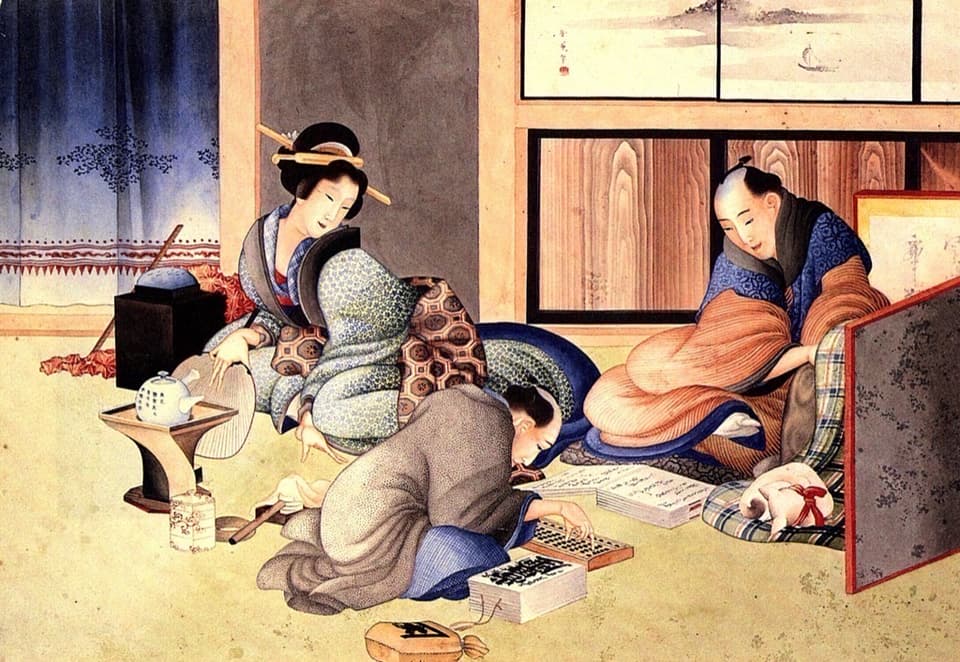
A Merchant Making Up the Account (1833), Katsushika Hokusai, Edo (Tokyo)
Notice the details that place this scene in an Edo townhouse: tatami mats, sliding paper doors (fusuma) decorated with landscape paintings, the hibachi-style tea stand, and a folding screen at the edge of the room. In the 1830s Hokusai was also at work on Thirty-Six Views of Mount Fuji, the series that includes The Great Wave off Kanagawa. Its dramatic blues came from Prussian blue, an imported synthetic pigment that had recently become affordable in Japan.
A Final Ascent: Dragon Flying over Mount Fuji
In the postscript to his One Hundred Views of Mount Fuji (1834), Hokusai wrote that nothing he had produced before the age of seventy was worth notice, and that he hoped by 110 every dot and line he drew would seem alive. In his last years he signed himself Gakyō Rōjin Manji, "Manji, the Old Man Mad About Painting."
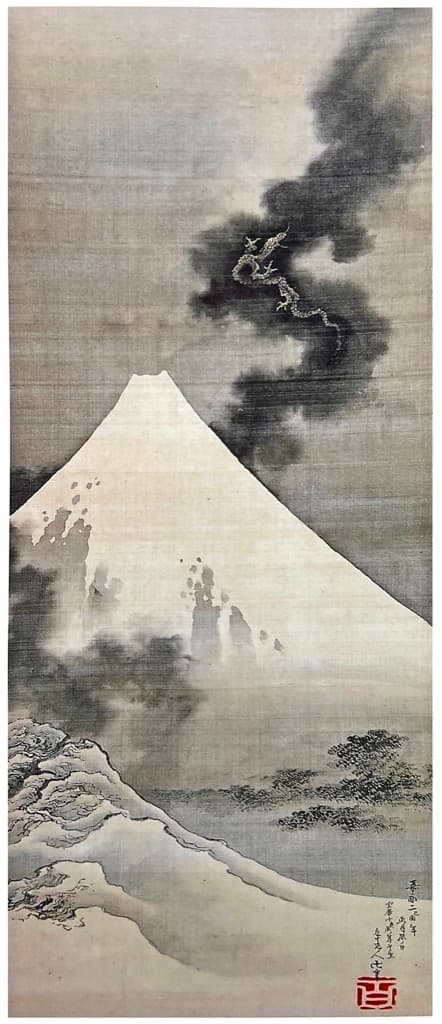
Dragon Flying over Mount Fuji (1849), Katsushika Hokusai, hanging scroll, Hokusai-kan Museum, Obuse
Dragon Flying over Mount Fuji is one of his very last works, dated to the first month of 1849, a few months before his death that spring. A black storm cloud rises past the snow-white cone of Fuji, and inside it a dragon twists upward. Many people read it as Hokusai's own spirit leaving the world. Hokusai made several long visits to the mountain town of Obuse in Nagano in his eighties, at the invitation of his patron, the merchant and scholar Takai Kōzan. The scroll is now held by the Hokusai-kan museum there, and that is where ArtGuess pins it. A Hokusai work pinned outside Tokyo is a rare exception worth remembering.
Hiroshige: The Poet of the Road
Hiroshige was born in 1797 into a family of Edo fire wardens, a samurai post he inherited as a boy while he trained as an artist under Utagawa Toyohiro. Where Hokusai was bold, dramatic and endlessly inventive, Hiroshige was lyrical. He paid close attention to weather, time of day and the small human figures who move through a landscape.
His breakthrough came with The Fifty-Three Stations of the Tōkaidō (1833–1834). The Tōkaidō was the most important highway in Japan, running about 500 kilometers along the Pacific coast from Nihonbashi bridge in Edo to Kyoto. Feudal lords were required to travel it regularly with their retinues, and along the way fifty-three official post towns offered inns, horses and porters. Tradition holds that Hiroshige traveled the road himself in 1832 with an official delegation, although scholars still debate how much of the series he drew from life.
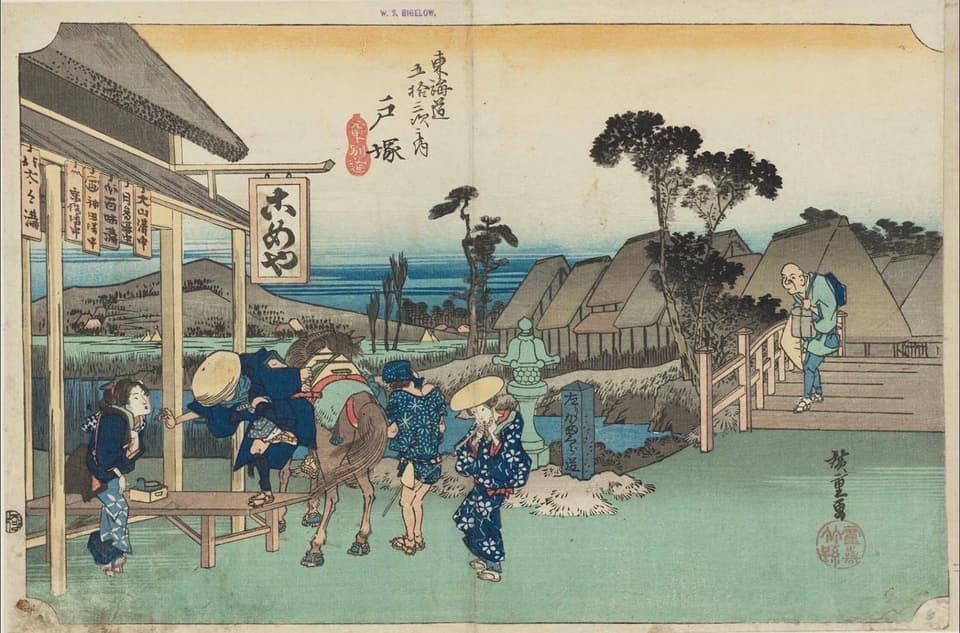
Totsuka, the 5th station of The Fifty-Three Stations of the Tōkaidō (1833), Utagawa Hiroshige, woodblock print
At Totsuka, the fifth station (today part of Yokohama), a traveler swings down from a packhorse outside a teahouse called Komeya. Hanging from its eaves are wooden plaques left by pilgrimage associations, and the stone marker beside the bridge points the way to Kamakura, since a side road to the old shogunal capital branched off here. Hiroshige gives us a busy, accurate picture of a real place on the highway, complete with signage.
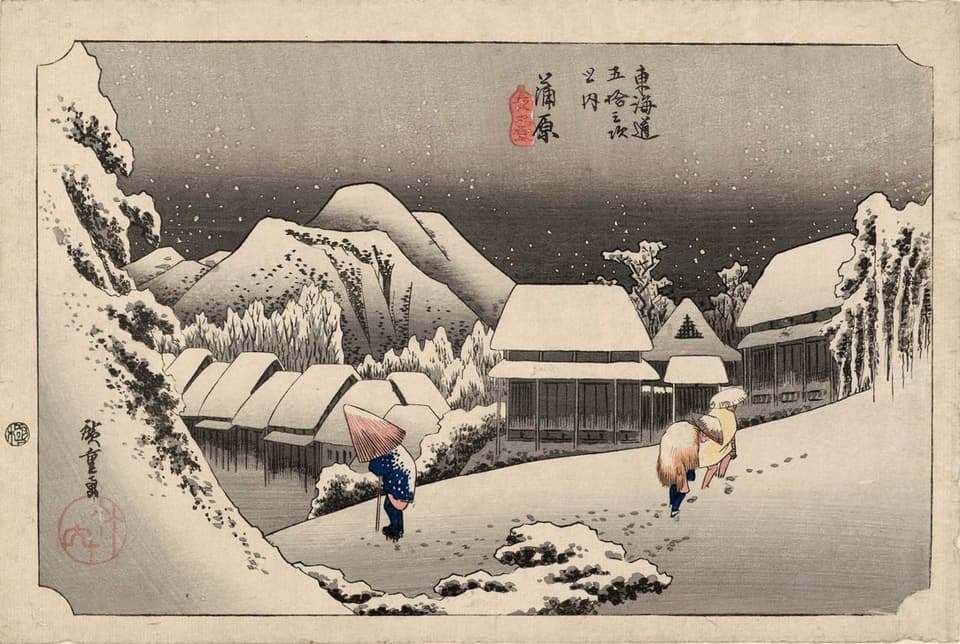
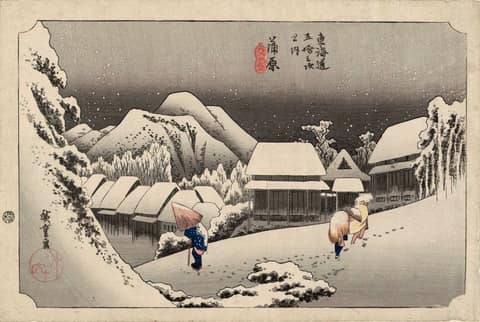
Kanbara: Night Snow, the 15th station of The Fifty-Three Stations of the Tōkaidō (1833), Utagawa Hiroshige, woodblock print
Kanbara, the fifteenth station, is one of the most admired prints in the series. Heavy snow muffles the village at night, and three hunched travelers trudge through it, one with a straw raincoat and two under wide hats. The scene is unusual because Kanbara, in today's Shizuoka Prefecture, has a mild coastal climate and rarely sees snow like this. Hiroshige chose the mood over strict accuracy, a reminder that even "topographical" art is interpreted. The gradation from black sky to white snow was printed by hand-wiping ink across the block (bokashi), a technique that skilled printers used to produce soft shifts in tone.
One Hundred Famous Views of Edo
At the end of his life Hiroshige returned to his home city. One Hundred Famous Views of Edo (1856–1858) used a tall, vertical format and bold cropping, often placing a branch, a post or a tree trunk right in the foreground. The series was published soon after the great Ansei earthquake of 1855, and many of its scenes show a city in recovery, with crowds back out enjoying the seasons. Hiroshige died in 1858 before it was finished.
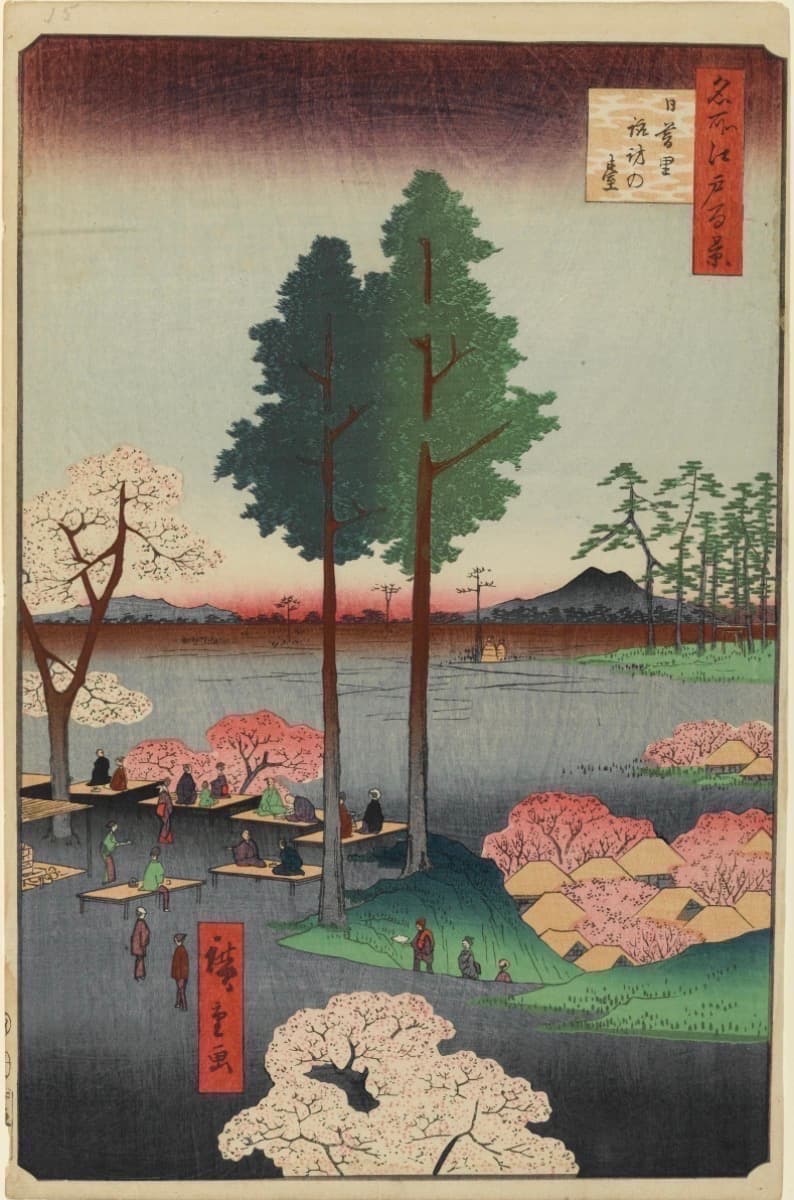
Suwa Bluff in Nippori (1856), One Hundred Famous Views of Edo
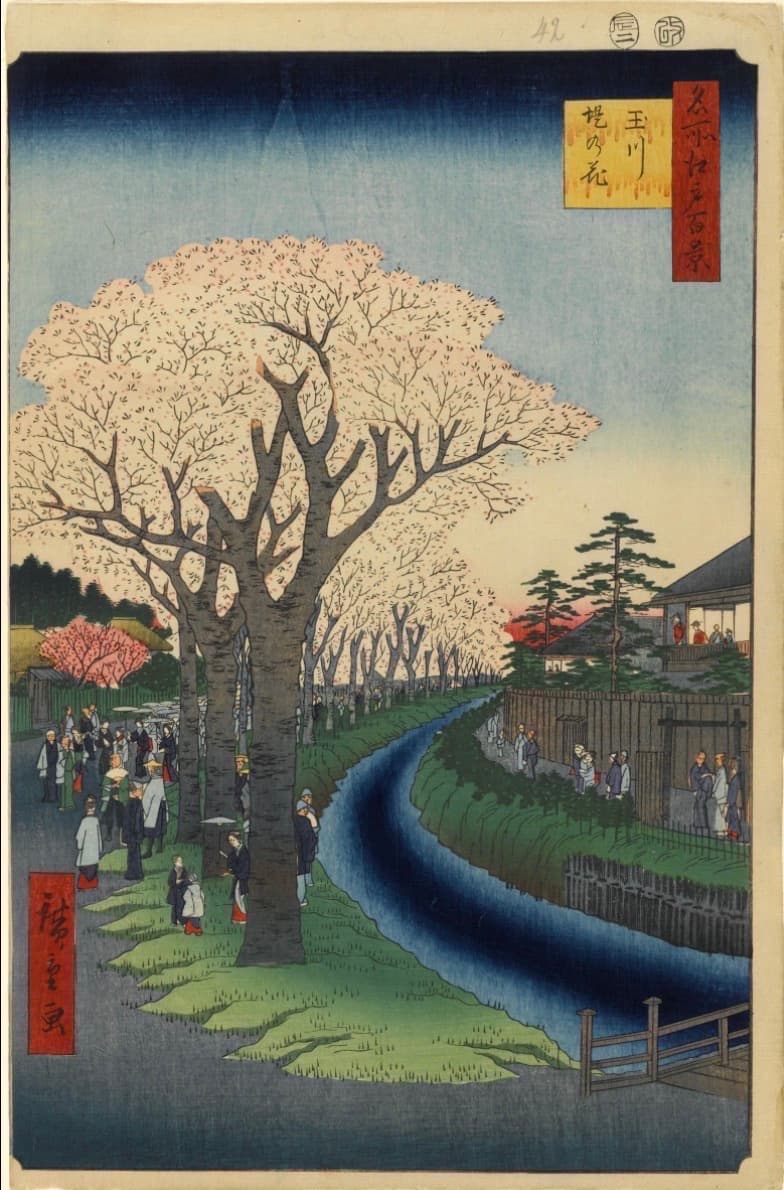
Cherry Blossoms on the Banks of the Tama River (1856), One Hundred Famous Views of Edo
Both of these are spring views. On Suwa Bluff in Nippori, on the northern edge of the city, picnickers sit on benches among blossoming cherry trees, looking out over flooded rice fields toward a distant blue peak. Cherry Blossoms on the Banks of the Tama River shows a crowd strolling beneath an avenue of flowering trees beside a narrow, curving channel of the Tamagawa Aqueduct, which carried drinking water into Edo. These were the cherry-viewing (hanami) spots of their day, and Edo's residents would have recognized them instantly.
European artists noticed. In 1887 Vincent van Gogh painted careful oil copies of two prints from this series, Plum Park in Kameido and Sudden Shower over Shin-Ōhashi Bridge. The flat color, high horizons and daring cropping of Hiroshige's views became part of the visual language of Impressionism and Post-Impressionism, a movement known as Japonisme.
Hokusai vs. Hiroshige: How to Tell Them Apart
Pinpointing Japanese Prints in ArtGuess
Here are the clues that will help you place these works quickly and accurately:
- Read the cartouche, even if you can't read Japanese: Prints usually carry a colored title panel in a corner. A long red vertical strip next to a smaller square panel is the hallmark of One Hundred Famous Views of Edo, so think Tokyo straight away.
- Remember where prints were made: Almost all ukiyo-e were designed and published in Edo, even when they depict distant places. When in doubt, a guess in central Tokyo is the safe choice for a woodblock print.
- Look for Mount Fuji: The perfect snow-capped cone appears constantly, seen from Edo, the Tōkaidō and the lakes around its base. If Fuji fills the frame of a painted scroll rather than a print, consider locations outside the capital.
- Spot the gods and the daily life: The Seven Gods of Good Fortune, abacuses, tatami rooms and sliding doors all point to Japan, and specifically to the merchant culture of Edo.
- Don't confuse Japan with China: Chinese landscape painters such as Wang Hui and Yun Shouping, who also appear in ArtGuess, worked in ink and soft color on long scrolls with towering, misty mountains and dense calligraphic inscriptions. Ukiyo-e prints have crisp outlines, flat areas of bright color and everyday subjects.
Try it yourself: Set the continent filter to Asia and the century filter to the 19th century to practice on the Edo-period works in the database, or challenge friends to a multiplayer match. New to the game? Start with our How to Play guide.
A Lasting Legacy
Within a decade of Hiroshige's death, the shogunate fell, Edo was renamed Tokyo, and Japan began a rapid modernization that swept away much of the world these two artists recorded. The teahouses of Totsuka and the cherry trees of Nippori survive mostly in their prints. That makes Hokusai and Hiroshige more than great artists: they left a historical record of a country on the eve of enormous change. Look closely at their work and you can still make the trip from Nihonbashi toward Kyoto, one post station at a time.